'Mizuna' Asian Green – traditional Japanese landrace with a mild, sweet-spicy flavor.
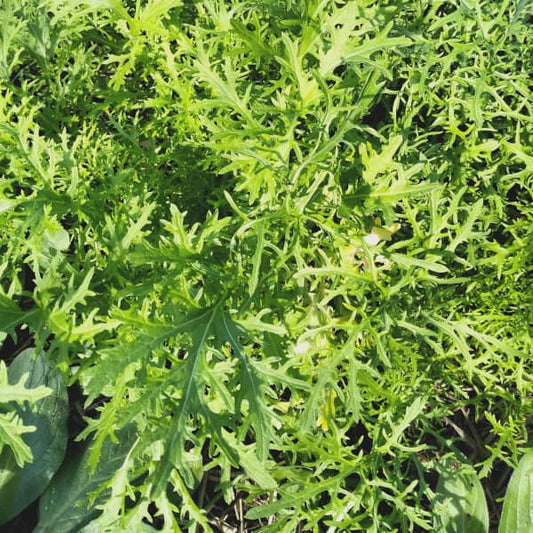
This variety is a fast-growing leafy vegetable from Japan with deeply feathered, light green leaves and dense rosette growth. Its mild cabbage flavor is delicate and sweet-spicy with a fine mustard note reminiscent of broccoli and arugula. Slightly frost-tolerant, high-yielding, and well suited for open field, greenhouse, and pot cultivation. Open-pollinated, easy to grow, and robust – ideal for self-sufficiency gardens and organic farming.
 Origin & History
‘Mizuna’ belongs to Brassica rapa var. nipposinica and is a traditional Japanese crop whose use can be traced back to the Middle Ages (ca. 14th–16th century). It was mentioned in historical sources from Kyoto as “Kyō-na” (京菜, “Kyoto vegetable”) and is counted among the Kyō-yasai, the traditional vegetable varieties of Kyoto. Thus, it represents an old, handed-down leafy vegetable form with strong regional roots. This species is part of the Brassicaceae family and belongs to the large Brassica rapa group, which also includes Chinese cabbage, pak choi, and turnips.
Cultivation of ‘Mizuna’ developed particularly in the Kyoto area, where it was valued as a winter vegetable and traditionally used in soups (nabemono), stews, and pickled (tsukemono). Its significance as a regional landrace has been preserved to this day. In European seed catalogs, Mizuna only appeared in the late 20th century (1980s–1990s), when Asian salads became popular. Since then, it has established itself as a favored variety in modern vegetable gardens. Today, it is maintained by enthusiasts, organic seed initiatives, and conservation projects, and preserved as a freely accessible, open-pollinated crop.
 Appearance & Characteristics
The plant grows in a dense rosette and reaches a height of about 45 cm. It produces numerous deeply feathered leaves and is winter-hardy down to -5 °C.
Leaf details:
- Size: Medium
Form: Deeply feathered, finely serrated
Color: Light green
Texture: Tender to firm, depending on harvest time
Flavor: Mild, delicate, sweet-spicy with a fine mustard note - versatile use
 Usage & Cultivation Highlights
‘Mizuna’ leaves are versatile: young leaves enrich salads with a mild-spicy aroma and a delicate broccoli-arugula flavor, while older leaves develop a stronger note. They are suitable for steaming, cooking, stir-frying, soups, and stews, traditionally used in Japanese cuisine, and are also decorative. In addition, they can be pickled (tsukemono), used in hot pot dishes (nabemono), as a topping for noodle and rice dishes, or processed fresh in smoothies and green juices.
Thanks to good cold tolerance and resilience, ‘Mizuna’ grows reliably in open field, greenhouse, and pots. Easy to care for, cut-tolerant, and productive, it delivers stable yields even at cooler temperatures over a long period. The variety also convinces with rapid development, enabling early harvests. It is highly adaptable to different soils, regenerates well after cutting, remains stable even under variable weather conditions, and shows robustness against common brassica diseases – ensuring continuous harvests over several months.
Compared to other Asian greens, ‘Mizuna’ is particularly mild in flavor – ideal for those seeking open-pollinated mustard greens with delicate aroma and traditional Japanese character.


![American Mountain Mint [Pycnanthemum pilosum]](http://www.benjis.net/cdn/shop/files/AmerikanischeBergminze-Americanmint-Pycnanthemumpilosum-www.benjis.net.jpg?v=1704292329&width=533)
![Anise [Pimpinella anisum]](http://www.benjis.net/cdn/shop/files/Anise_-_Pimpinella_anisum_-_www.benjis.net.jpg?v=1738942704&width=533)
![Apple mint [Mentha rotundifolia]](http://www.benjis.net/cdn/shop/files/Apfelminze-Applemint-Hortelamaca-Mentharotundifolia-www.benjis.net.jpg?v=1763734068&width=533)
![Artischoke Imperial Star [Cynara cardunculus var. scolymus]](http://www.benjis.net/cdn/shop/files/ArtischockeImperialStar-Artichoke-Alcachofra-Cynaracardunculusvar.scolymus-www.benjis.net.jpg?v=1705194551&width=533)