Common Daisy – robust perennial wild plant with edible flowers and traditional medicinal properties.
Perennial and long-lived wild herbaceous plant with small white flowers and a yellow center. It grows vigorously, is winter-hardy, and is suitable for open ground, containers, and naturalistic gardens. It germinates reliably and is ideal for self-sufficiency and ecological medicinal herb cultivation.
 Origin & History
The common daisy (Bellis perennis) in its natural form is one of the oldest and most widespread medicinal and cultivated plants in Europe. Its original range covers nearly all of Europe, the Mediterranean region, and parts of Western Asia, where it primarily grows in open meadows, along roadsides, and on extensively managed grasslands. Botanically, the species belongs to the family Asteraceae, the subfamily Asteroideae, and the genus Bellis. The name Bellis derives from the Latin bellus (“beautiful”), while perennis (“perennial”) refers to the long‑lived growth habit of the wild form.
The earliest mention appears in the writings of Pliny the Elder in the 1st century AD, who described the daisy as a medicinal plant used for wounds and skin injuries. Dioscorides also included it in De materia medica, documenting its continuous medicinal use since antiquity. In medieval herbals, Bellis perennis is regularly listed as a remedy for bruises, swelling, and skin irritation, and it was cultivated in monastic gardens as a robust and easily accessible medicinal plant.
Over the centuries, the wild form spread far beyond its original range through natural dispersal and human use. It became native throughout Europe and was later introduced to North America, Australia, and New Zealand, where it established quickly thanks to its high adaptability. Its flowers, which open in sunlight and close in rain or darkness, are considered a classic example of nyctinasty and shaped its symbolic meaning as a plant of light and purity.
Due to its long history of use, its resilience, and its content of secondary plant compounds such as saponins, flavonoids, and tannins, the wild form of Bellis perennis remains one of the most important traditional medicinal plants in Europe. The common daisy forms the genetic foundation of all later cultivated varieties and continues to be the most ecologically valuable and widespread form of the species.
 Appearance & Characteristics
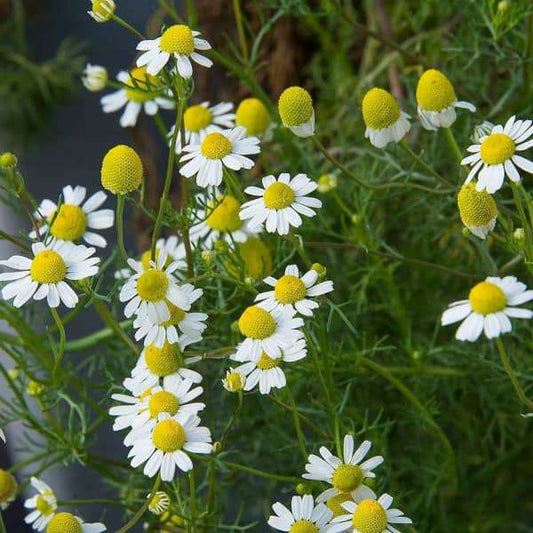
The plant is perennial and herbaceous, forming low rosettes with spatulate to spoon-shaped, slightly hairy leaves. The white ray florets with a yellow center appear from spring through autumn. Bellis perennis develops short, creeping rhizomes and fine roots. The species is winter-hardy and tolerates temperatures down to approximately −30 °C, depending on the site.
Plant details:
Height: Low, 5–15 cm
Form: Rosette-forming, flat, compact
Leaves: Spatulate to spoon-shaped, slightly hairy
Flowers: White with a yellow center, capitulate
Flavor: Mildly nutty, slightly bitter, aromatic
 Usage & Cultivation Highlights
Common daisy is ideal for salads, edible decoration, tea, natural cosmetics, and traditional herbal applications. Its anti-inflammatory compounds have long been used for skin issues, bruises, coughs, and digestive discomfort. Applied externally, it soothes irritated skin and supports wound healing. The flowers enhance salads, herb spreads, soups, smoothies, and wild herb blends. In herbal medicine, they are used to strengthen the immune system, support recovery from colds, and promote gentle detoxification. Fresh flowers serve as an aromatic ingredient in herb butter, pestos, and floral vinegars, while the buds are pickled as the “capers of the North.” In natural cosmetics, flower extracts form the basis of nourishing oils, salves, and washes. Syrups, honey infusions, herbal baths, and compresses traditionally support the respiratory system, skin regeneration, and metabolism, making the plant a versatile component of spring tonics.
Common daisy grows reliably outdoors and in containers. The plant is low-maintenance, winter-hardy, and can be harvested for many years. Its flowers attract numerous beneficial insects such as bees and bumblebees, supporting ecological balance in the garden. Thanks to its robust nature, it continues to thrive even in less-than-ideal soils, regenerates quickly after each cut, and allows multiple harvests. It forms long-lived clumps and is well suited for lawns, pathways, and naturalistic gardens. Overall, it shows strong tolerance to dry periods and fluctuating weather conditions. The wild form thrives in full sun or partial shade and performs well in nutrient-poor, compacted, or slightly acidic soils. It is resilient enough to withstand foot traffic in meadows and lawns and spreads reliably through short rhizomes and self-seeding without becoming invasive. With its early flowering period, it provides an important food source for pollinators in early spring and extends the garden’s blooming season.
Compared to other wildflowers, common daisy is a classic traditional medicinal plant with delicate ornamental blooms, ideal for those who appreciate low-maintenance, perennial wild herbs that offer high ecological value for insects.