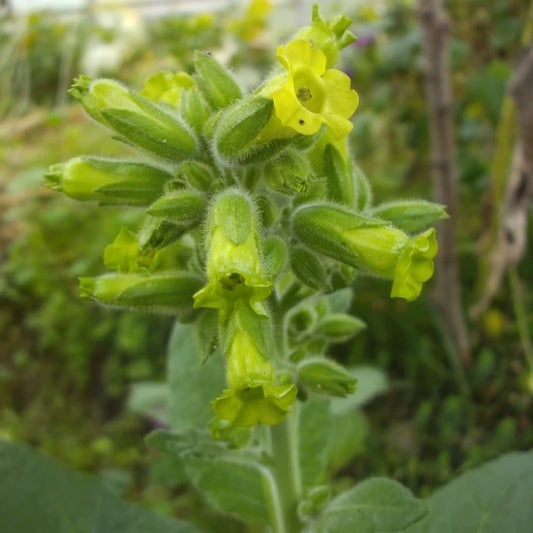
Tobacco
Tobacco – its origins lie in the warm regions of Central and South America, where early forms emerged from wild nightshade species and were cultivated and used by Indigenous cultures. Through trade routes, tobacco later reached Europe, Africa and Asia, where numerous regional types developed over time. The most important cultivated species are Nicotiana tabacum and Nicotiana rustica, from which today’s broad‑leaved, medium‑sized and more compact types evolved. The diversity includes colour variations from light green to deep green, as well as slightly reddish or yellowish tones. Leaf structure also varies by variety, ranging from smooth to gently wavy to particularly robust.
In subtropical climates, tobacco thrives during the warm seasons, as it requires a long vegetation period and consistently warm temperatures. In temperate regions, many of our traditional and historically preserved varieties also perform well, since some types—with their shorter cultivation period—grow reliably even in shorter summers and develop uniform, aromatic leaves. Tobacco shows notable ecological adaptability and can be cultivated successfully in many climate zones when sown at the appropriate time.