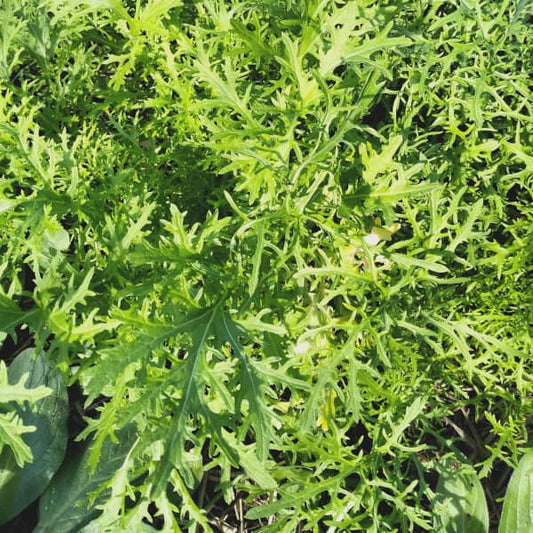
The annual rocket is a salad and spice plant that was already used by the Romans. It has a nutty taste, similar to mustard and cress. Milder than wild rocket. Ideal for direct sowing, pot cultivation possible, sowing spring-summer-autumn-winter, good for mixed culture, harvest the leaves.
Description
Rocket is an annual salad and herb plant. It is the cultivated form of the wild plant Diplotaxis tenuifolia, which originally comes from the Mediterranean region and was already used by the Romans. The sun-loving plant has slightly hairy and feathery leaves, similar to dandelions. The taste is a combination of nuts, mustard and cress and is milder than that of the original wild plant. They germinate and grow quite quickly and are usually ready to harvest after just six weeks.
General information
Plant family: Brassicaceae
Life cycle: Annual
Days to harvest: 50 days
Plant height approx.: 40 cm
Root type: Shallow rooter
Nutrient requirements: Low
Water requirements: Medium
Winter hardiness: Up to -10°C
Location: Sunny until semi shady
Soil: Permeable, humus-rich sandy loam soil
pH value: 6 to 8
Sowing and planting information
Germination type: Light germinator
Sowing depth: 0 cm
Optimal germination temperature: 10-16 °C
Germination time: 3-6 days
Plant and row spacing: 15x25 cm
Germination ability of seeds: 5-6 years
Mixed culture
Optimal mixed culture: Marigold
Unfavorable mixed culture: Asian salad, Mustard, Cress, Nasturtium
Sowing by climate zone
Subtropic climate (Mediterranean) (e. g. B. Portugal, Spain, Italy)
Direct sowing from March to October is recommended. The plants should ideally be planted in a partially shaded location.
Moderate climate (e. g. B. Germany, Switzerland, Poland)
Direct sowing from April to August is recommended. The plants should ideally be planted in a sunny location.
General recommendations
Direct sowing is recommended. After germination, thin out the plants to the specified plant spacing.
Rocket prefers well-drained, humus-rich, sandy to loamy soils. Good soil moisture is also important, as arugula has shallow roots. It is relatively undemanding and therefore only needs moderately nutrient-rich soils. Doesn't tolerate waterlogging.
Additional tips
If there is too much nitrogen, nitrate accumulates in the leaves. The plant flowers rapidly in extreme heat, which results in a more bitter flavor in the leaves. In subtropical climates, it is advisable to place plants in partial shade or apply mulch to keep the soil cool. Regular watering can also help reduce heat stress. As an alternative, the cultivar 'Diplotaxis tenuifolia' can be used, which generally has a higher heat tolerance. In order to quickly obtain a fine, crumbly and permeable soil with good nutrient and water storage capacity, it is recommended to additionally incorporate biochar and primary rock flour.
Type of propagation
Propagation occurs via seeds.
Plant care
Regular watering results in faster growth. No fertilization necessary.
Other names
Botanical names: Eruca sativa, Eruca vesicaria subsp. sativa
English names: Rocket, Arugula
German names: Salatrauke, Senfrauke, Rucola
Portuguese names: Rúcula
Spanish names: Rúcula
French names: Roquette cultivée
Origin
Country: Portugal


![American Mountain Mint [Pycnanthemum pilosum]](http://www.benjis.net/cdn/shop/files/AmerikanischeBergminze-Americanmint-Pycnanthemumpilosum-www.benjis.net.jpg?v=1704292329&width=533)
![Anise [Pimpinella anisum]](http://www.benjis.net/cdn/shop/files/Anise_-_Pimpinella_anisum_-_www.benjis.net.jpg?v=1738942704&width=533)
![Apple mint [Mentha rotundifolia]](http://www.benjis.net/cdn/shop/files/Apfelminze-Applemint-Hortelamaca-Mentharotundifolia-www.benjis.net.jpg?v=1763734068&width=533)
![Artischoke Imperial Star [Cynara cardunculus var. scolymus]](http://www.benjis.net/cdn/shop/files/ArtischockeImperialStar-Artichoke-Alcachofra-Cynaracardunculusvar.scolymus-www.benjis.net.jpg?v=1705194551&width=533)