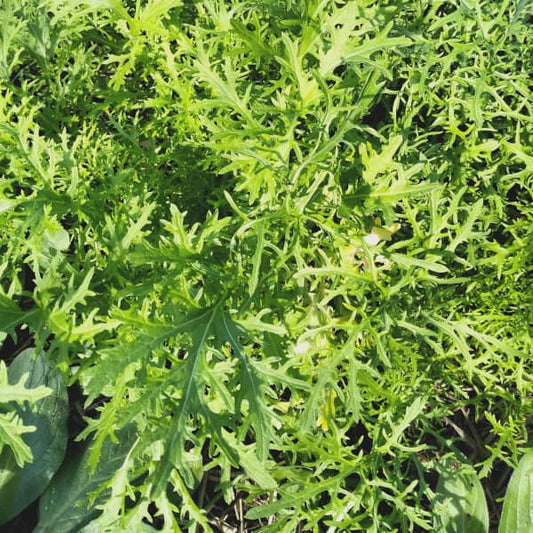
'Red Russian' Kale – historic heirloom variety with red-green, tender leaves and a mild, sweet flavor.
This hardy leafy kale features striking red-green, tender leaves that are soft and juicy. After the first frost, they develop an especially mild, sweet flavor. The plants grow vigorously, are high-yielding, and thrive in open fields. Open-pollinated and easy to care for – perfect for self-sufficiency and organic cultivation.
 Origin & History
'Red Russian' is an open-pollinated kale with a long history dating back to the 19th century. The first mentions of this variety appeared as early as 1863, before Russian traders brought it to Canada around 1885, where it quickly established itself as a hardy winter crop. It belongs to the so-called Russo-Siberian kales (Brassica napus var. pabularia), which are distinguished by their more tender, less curled leaves and mild flavor, setting them apart from the classic European kales (Brassica oleracea var. sabellica). In gardening terminology, however, it is often referred to as kale, since its cultivation and use are closely linked to the European forms.
Traditional selection of 'Red Russian' focused on producing a winter-hardy, high-yielding kale with tender leaves, strong cold tolerance, and a particularly mild, sweet flavor after exposure to frost. These qualities made 'Red Russian' one of the most popular varieties for autumn and winter growing. Preserved over generations through careful seed stewardship, it is now considered one of the best-known historic kale varieties worldwide.
Its most distinctive feature is the striking red-green leaves with purple-red veins and stems, valued not only for their culinary qualities but also for their visual appeal. In North America, 'Red Russian' became a staple of winter cuisine and was later rediscovered in Europe, where it is appreciated as an open-pollinated alternative to modern hybrids. Its reputation as a tender, delicately flavored variety has helped it remain popular in both home gardens and commercial cultivation, where it continues to be preserved and passed on through traditional seed saving.
 Appearance & Characteristics
The plant grows upright and reaches a height of about 80 cm. It produces numerous deeply lobed, red-green leaves with purple-red veins and stems. The leaves are noticeably softer than those of many other kale varieties. Hardy down to around -15 °C, its flavor improves significantly after frost.
Leaf details:
Size: Medium to large, leaves about 15-25 cm long
Shape: Deeply lobed, slightly curled, loosely arranged
Color: Blue-green with purple-red veins and stems
Texture: Tender, juicy, less coarse than other kale varieties
Flavor: Mild-sweet, especially after frost, with a slightly nutty note
 Usage & Cultivation Highlights
The leaves of 'Red Russian' are well suited for fresh use in salads, smoothies, and as a garnish. Their mild-sweet flavor and tender texture make them a versatile winter vegetable. They can be steamed, sautéed, or blanched as a side dish, enhance soups, stews, casseroles, pestos, and dips, and are popular in diet and low-carb cuisine. Modern dishes such as wraps, bowls, and sandwiches also benefit from their tenderness. They can be made into chips, dried, or fermented, and are suitable for juices, detox programs, and nutrient-rich powders. Traditionally valued as a winter vegetable, they are both decorative and versatile in the kitchen.
Thanks to their winter hardiness and vigorous growth, 'Red Russian' thrives reliably in open fields as well as in greenhouses and containers. The variety is easy to care for, adapts well to different locations, and delivers stable yields even at low temperatures. Particularly noteworthy are the tender leaves, which allow for a wide range of uses, and the high cold tolerance that makes 'Red Russian' especially suitable for organic cultivation. In addition, the variety is characterized by rapid juvenile growth, enabling early harvests, and by continuous leaf regrowth, allowing multiple harvests throughout the season. It is less susceptible to common kale diseases and shows good resilience to changing weather conditions. It also grows reliably on medium soils.
Compared to other kale varieties, 'Red Russian' is especially tender and mild in flavor – a robust, winter-hardy variety, ideal for anyone who values open-pollinated kale with versatile use, attractive appearance, and reliable growth.