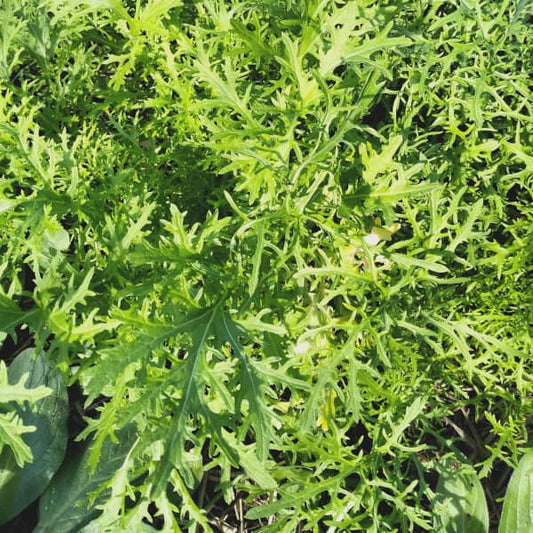
The perennial Asian mint Jing-Jie is a tea and medicinal plant and has a slightly euphoric effect on people when drunk as a tea. The leaves have a distinct but not too strong mint aroma and a fruity taste, with a low menthol content. Important bee pasture. Ideal for direct sowing, pot cultivation possible, sowing spring-autumn, good for mixed culture, harvesting the leaves.
Description
The Asian mint Jing-Jie is a very old, perennial tea and medicinal plant from East Asia and has a long history of use in traditional Asian medicine. The medicinal plant, which has been known and used for centuries, belongs to the catnip family and, when drunk as a tea, has a slightly euphoric effect on people. The plants form finely hairy, elongated-oval, velvety and deep green leaves that have a distinct but not too strong mint aroma and a fruity taste, with a low menthol content.
General information
Plant family: Lamiaceae
Life cycle: Perennial
Days to harvest: 70 days
Plant height approx.: 70 cm
Root type: Deep rooter, runner-forming
Nutrient requirements: Medium
Water requirements: Low
Winter hardiness: Up to -20°C
Location: Sunny until semi shady
Soil: Permeable, humus-rich loamy soil
pH value: 6.5 to 7.5
Sowing and planting information
Germination type: Light germinator
Sowing depth: 0 cm
Optimal germination temperature: 15-20 °C
Germination time: 14-21 days
Plant and row spacing: 50x50 cm
Germination ability of seeds: 2-3 years
Mixed culture
Optimal mixed culture: Cabbage, Wine, Apple, Pear, Tomato, Walnut, Potato
Unfavorable mixed culture: Mint
Sowing by climate zone
Subtropic climate (Mediterranean) (e. g. B. Portugal, Spain, Italy)
We recommend direct sowing from January to April or in autumn from October to December. The ideal location for the plants is sunny to partially shaded.
Moderate climate (e. g. B. Germany, Switzerland, Poland)
Direct sowing from March to May is recommended. The ideal location for the plants is warm, sunny to partially shaded.
General recommendations
Direct sowing is recommended. After germination, thin out the plants to the specified plant spacing.
Asian mint Jing Jie prefers a permeable, nutrient-rich, moist and humus-rich loamy soil. Doesn't tolerate waterlogging.
Additional tips
Protects vegetable plants from leaf beetles and flea beetles. Keeping the plants in pots is possible and often recommended to prevent spread through root runners. Forms underground runners. In order to quickly obtain a fine, crumbly and permeable soil with good nutrient and water storage capacity, additional incorporation of biochar and primary rock flour is recommended.
Type of propagation
Propagation occurs via seeds or root runners.
Plant care
Pruning in summer encourages the growth of new shoots. If natural spreading is not desired, the underground roots can be cut with a spade in spring. During long dry periods, it is advisable to give the plants extra water. Fertilizer is only necessary when growing in containers.
Other names
Botanical names: Schizonepeta tenuifolia
English names: Asian mint
German names: Asiatische Minze, Japanische Katzenminze, Chinesische Minze, Jing-Jie, Keigei, Kaigai, Menta asiática
Portuguese names: Hortelã-pimenta
Spanish names: Menta asiática
French names: Menthe asiatique
Origin
Country: Portugal


![American Mountain Mint [Pycnanthemum pilosum]](http://www.benjis.net/cdn/shop/files/AmerikanischeBergminze-Americanmint-Pycnanthemumpilosum-www.benjis.net.jpg?v=1704292329&width=533)
![Anise [Pimpinella anisum]](http://www.benjis.net/cdn/shop/files/Anise_-_Pimpinella_anisum_-_www.benjis.net.jpg?v=1738942704&width=533)
![Apple mint [Mentha rotundifolia]](http://www.benjis.net/cdn/shop/files/Apfelminze-Applemint-Hortelamaca-Mentharotundifolia-www.benjis.net.jpg?v=1763734068&width=533)
![Artischoke Imperial Star [Cynara cardunculus var. scolymus]](http://www.benjis.net/cdn/shop/files/ArtischockeImperialStar-Artichoke-Alcachofra-Cynaracardunculusvar.scolymus-www.benjis.net.jpg?v=1705194551&width=533)