Artichoke 'Imperial Star' - Cynara cardunculus var. scolymus

€3,00 EUR
€2.857,14 EUR 1kg
Price plus shipping
Delivery time: 1-2 business days (PT – international may vary)
reicht für ca. 20 plants

In stock

Modern classic. Open-pollinated & non-hybrid – 100% free from genetic engineering & synthetic fertilisers. Ecologically propagated – non‑proprietary variety.
Bohnensamen2

Harvest year:

2024

Seed viability:

Up to 4 years (species-specific)
Detailed information on germination capacity

Description

Cultivation & Characteristics

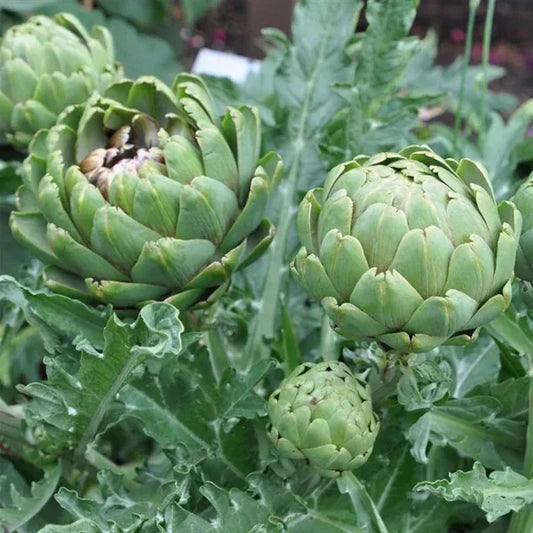
Artichoke ‘Imperial Star’ – an early-cropping variety with large, almost spineless heads.

The large, rounded heads of this open-pollinated variety have fleshy hearts and a pleasantly mild, slightly sweet flavour. With early sowing under cover and a cool development period, the plants can produce a generous harvest in their first year. The large main heads are followed by several smaller side heads, which can be harvested in succession. Unharvested buds open into decorative purple flowers that attract pollinators and can also be used as cut flowers. The variety is suitable for perennial cultivation in Mediterranean climates and particularly for growing as an annual in Central European climates.

  Origin & History

‘Imperial Star’ was developed in California through a breeding programme at the University of California. Wayne L. Schrader and Keith S. Mayberry developed the variety specifically for growing from seed with a harvest in the first year. The breeding material originated from progeny of a cross between French and Italian artichoke lines. From 1986 onwards, plants were selected for early maturity, uniform heads and good yields. Further selection up to 1989 established the characteristic glossy, almost spineless heads.

‘Imperial Star’ was documented under its name by 1990 and received plant variety protection in the United States in 1991. The variety made it possible to grow artichokes as an annual crop from seed while producing marketable heads and was trialled both in coastal areas and in the warm inland regions of Southern California. This helped make cultivation outside the traditional perennial artichoke-growing areas more significant. Today, ‘Imperial Star’ is offered as an open-pollinated variety that is particularly valued for its early cropping, making it well suited to gardens with a limited growing season.

 Appearance & Characteristics

The vigorous plants form a spreading rosette of deeply divided, dark green to grey-green leaves with prominent pale leaf ribs. Including the branching flower stems, they usually reach around 100–150 cm in height. The larger heads develop at the tips of the main shoots, while smaller heads form on the side shoots. The variety is moderately winter-hardy; overwintering outdoors requires a well-drained site and protection during severe frost.

Bud & flower details:

  • Size: Large main heads around 8–12 cm in diameter; side heads remain smaller

  • Shape: Rounded to spherical, with tightly overlapping, almost spineless outer bracts

  • Colour: Green with a noticeably glossy surface, occasionally slightly purple at the base; open flowers are purple

  • Texture: Fleshy hearts and bract bases, tender after cooking

  • Flavour: Mild and aromatic with a slightly sweet note

 Usage & Cultivation Highlights

The large heads are suitable for boiling and steaming and can be served whole with a vinaigrette or dip. The tender hearts can also be grilled, stuffed or marinated as antipasti. Smaller side heads harvested young are particularly useful for frying and vegetable dishes. Once prepared and blanched, artichoke hearts can be frozen for storage, while fully opened flower heads add interest to fresh and dried flower arrangements.

One advantage at harvest time is the comparatively slow opening of the outer bracts, which helps the heads remain tightly closed and usable for longer. In mild regions, the variety can be planted in autumn and harvested the following spring. An even water supply during bud development supports the formation of well-filled heads, while prolonged periods of heat and drought can reduce their quality. Depending on the location and cultivation goal, ‘Imperial Star’ can be grown either as an annual crop for harvest or maintained as a perennial.

Compared with other artichoke varieties, the particular strength of ‘Imperial Star’ lies in its reliable first-year cropping when raised early and given a suitably cool development phase. Its large, almost spineless heads, mild flavour and slow-opening outer bracts make it a versatile choice for the kitchen and for gardens where the artichoke harvest should not depend on successful overwintering.

Cultivation_Overview_-_Anbau_im_Uberblick_-_Visao_geral_do_cultivo_-_www

Origin & Cultivation at a Glance

First mention:

1990

Origin:

USA – California

Breeder:

Wayne L. Schrader and Keith S. Mayberry

Propagation site:

Alentejo - Portugal

Suitable for:

Open field, Raised bed, Balcony / pot

Overwintering:

Winter-hardy – can be grown as a perennial outdoors, protect from severe frost.

Special features:

High-yielding, Sun-loving / sunny, Low-maintenance, Heat-tolerant, Cold-hardy
benjis-seeds-plant-growing-instructions-icon

Cultivation guide for

Artichoke 'Imperial Star'

Growing difficulty:

Easy

Care requirements:

Medium – requires some attention.
This variety grows best in deep, humus-rich and well-drained loamy soil. Before planting, loosen the soil thoroughly and incorporate well-rotted compost. Avoid soil compaction and waterlogging.

Sow the seeds 1–2 cm deep in pots, cover with soil and keep evenly moist. Germination usually takes 10–21 days. Around 3–4 weeks after sowing, once the first true leaves have developed, prick out individually into larger pots and continue growing in slightly cooler conditions.

When planting out, leave 90–100 cm between plants within the row and 100–150 cm between rows. Plant at the same depth as before and water thoroughly. Keep free from weeds, water sufficiently during vigorous growth and apply additional organic fertiliser as needed. Harvest the heads while the bracts are still tightly closed.

Mediterranes Klima

In Mediterranean climates, we recommend sowing under cover in pots from August to September or from January to February. Plant the young plants outdoors from October to November or from March to April in a sunny, warm and sheltered position. The cool winter period naturally encourages bud formation; for spring cultivation, allow for a cool period during the development of the young plants. Plants raised in autumn produce heads the following spring, while those raised in early spring are harvested from late spring into summer.

Mitteleuropäisches Klima

In Central European climates, we recommend sowing under cover in pots from February to March. Plant the young plants outdoors from mid-May after the last frosts in a sunny, warm and sheltered position. For a harvest in the first year, grow the young plants at 7–10 °C for 10–14 days before planting out and protect them from frost. Harvest from summer to early autumn; in this climate, the variety is usually grown as an annual.

Cultivation tips:

• Early sowing under cover and cool spring conditions encourage bud formation in the first year.
• Harvest the flower buds while the bracts are still tightly closed.
• Consistent watering improves bud quality and supports healthy plant growth.
• After germination, continue growing in a bright position at around 16 °C.
• Regular harvesting encourages the production of further flower buds.
• Rejuvenate plants after 4–5 years by division or replanting.

Storage instructions:

Store seeds in a cool, dry, dark, and airtight environment to maximize shelf life and germination.
Detailed information on seed storage
Plant_Profile_-_Pflanzen_Steckbrief_-_Ficha_da_planta_-_www

Plant Profile

Artichoke 'Imperial Star'

Plant details

Botanical name:
Cynara cardunculus L. 'Imperial Star'
Botanical family:
Asteraceae – daisy family
Plant type:
Flower vegetable
Growth habit:
Upright growth, Herbaceous, Forms a rosette, Clump-forming
Plant width:
100–150 cm
Plant height:
100–150 cm
Root type:
Deep-rooted, Taprooted
Hardy to:
−10 °C – protection recommended
Cultivation period:
3-5 years
Life cycle:
Perennial, long-lived (15 years or more possible)

Sowing & Planting

Germination type:
Light-independent germinator
Sowing depth:
1-2 cm
Germination temperature:
18-22 °C
Germination time:
10-20 days
Pot culture:
Not recommended - better grown in garden beds or raised beds.
Row spacing for baby leaf:
Not suitable for baby-leaf cultivation.
Plant spacing:
90–100 cm
Row spacing:
90-100 cm
Pricking out / thinning out:
3-4 weeks, thin out after formation of the first true leaf pairs.
Planting time:
Young plants raised under cover can be planted out around 5 weeks after sowing.

Soil

Soil type:
Deep, well-drained, humus-rich loam
Soil pH:
6.5–8.0 – neutral to alkaline
Nutrient requirements:
Moderate to heavy feeder
Soil moisture:
Evenly moist, Sensitive to waterlogging
Soil preparation:
Loosen the soil deeply before planting, Apply compost before planting., Mulch layer for moisture regulation

Companion planting, Crop rotation & Harvest

Companion plants:
Lettuce, Fennel, Pak choi, Rocket, Pea
Incompatible plants:
Celery, Onion crops
Crop rotation guidelines:
• Remains in the same location for several years.
• Allow at least 4 years before growing the same species in the same location again.
Sowing to harvest:
4–6 months with early sowing under cover; otherwise harvest in the second year
Harvested parts:
Closed flower buds – receptacles and fleshy bract bases
Suitable for consumption:
Yes - edible when cooked.
Intended use:
Steaming, Cooking, Grilling, Baking, Stuffing, Pickling, Deep-frying, Decoration

Care & Cultivation practices

Water requirements:
Moderate to high
Plant care techniques:
Water regularly - even during dry periods, Loosen and hoe, Fertilize, Maintain weed-free
Plant protection:
Slug protection recommended, Mulching recommended, Well-ventilated location and good drainage recommended.
Cultivation notes:
Susceptible to slugs and snails in early development. Can be infested by aphids - occasional monitoring recommended. Sensitive to waterlogging – use well-drained soil.
Propagation method:
Generative propagation by seed, Division possible
Propagation:
• This variety is pollinated by insects and belongs to the species Cynara cardunculus.
• For seed production, a minimum isolation distance of 250–800 m from other varieties of the same species is recommended, as cross-pollination can occur readily.
• For seed saving, collect seeds from 20–50 healthy, true-to-type plants.
• Seeds are ready for harvest once the seed heads are fully dried and slightly brittle.
• Allow harvested flower heads to finish drying in a well-ventilated place, remove the seeds, clean them and dry them thoroughly.

Other names

EN - English names:

• Artichoke • Globe artichoke

DE - German names:

• Artischocke • Gemüseartischocke

PT - Portuguese names:

• Alcachofra

ES - Spanish names:

• Alcachofa • Alcaucil

FR - French names:

• Artichaut

Customer Reviews

Be the first to write a review
0%
(0)
0%
(0)
0%
(0)
0%
(0)
0%
(0)

Reviews in Other Languages

Further recommendations for you

Open-pollinated and reproducible
Es gibt noch keine Produkte!