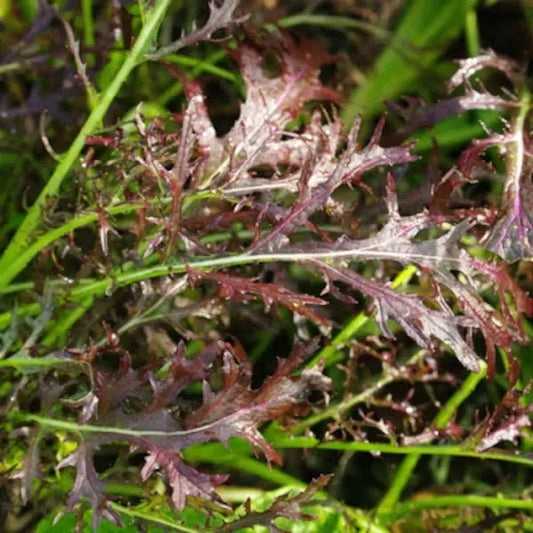
Buck’s-horn plantain - Plantago coronopus var. coronopus

€2,50 EUR
€5.000,00 EUR 1kg
Price plus shipping
Delivery time: 1-2 business days (PT – international may vary)
reicht für ca. 5 m²

In stock

Historical cultivated plant with wild origin – traditional, unchanged wild form. Regionally adapted landrace. Open-pollinated & non-hybrid – 100% free from genetic engineering & synthetic fertilisers. Ecologically propagated – non‑proprietary variety.
Bohnensamen2

Harvest year:

2023

Seed viability:

30 years (species-specific)
Detailed information on germination capacity

Description

Cultivation & Characteristics

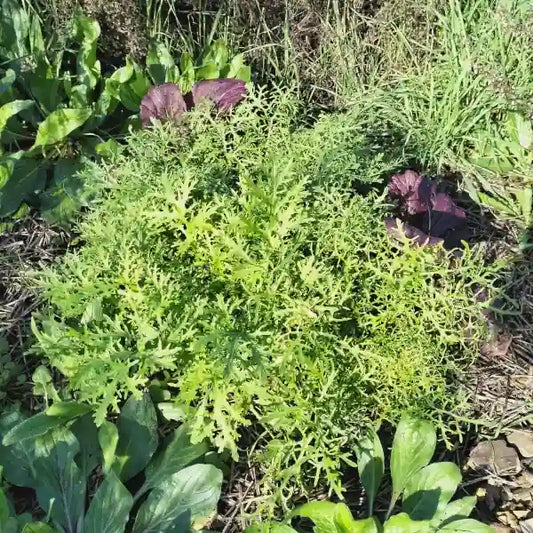
Buck’s-horn plantain – robust Mediterranean herb with spicy‑nutty leaves. 

This variety is a winter‑green, annual to short‑lived perennial herb vegetable with dark green, deeply cut leaves and a spicy‑nutty flavor. It grows compactly in rosette form, is robust, and is ideally suited for open field, greenhouse, and container culture. Salt‑tolerant, drought‑resistant, heat‑tolerant, and true‑to‑seed – perfect for self‑sufficiency and organic cultivation.


  Origin & History

Buck’s-horn Plantain belongs to the family Plantaginaceae. Originally native to coastal regions and salt meadows of Europe, North Africa, and Western Asia, the plant was already collected and valued in the Middle Ages as a nutritious wild vegetable. The German name derives from the characteristic shape of the leaves, which resemble a deer’s antlers.

In Mediterranean countries, especially Italy, Buck’s-horn Plantain is known as “Minutina” or “Erba stella” and has been cultivated there for centuries as a traditional winter vegetable. In France it is called “Plantain corne de cerf,” and in England “Buck’s-horn plantain.” Historically, it played an important role in the diet of coastal populations and was particularly appreciated in winter for its high content of vitamins and minerals.

Today, Buck’s-horn Plantain is experiencing a renaissance in modern cuisine and is preserved by seed initiatives as a valuable, true‑to‑seed wild vegetable. Its adaptability to extreme sites – from saline soils to dry, stony ground – makes it a symbol of resilient, climate‑adapted crops.


  Appearance & Characteristics

The plant grows compactly in a ground‑hugging rosette form and reaches a height of up to 30 cm. It produces numerous elongated, deeply cut, antler‑like leaves and shows high tolerance to salt, drought, and frost. Hardy down to about -12 °C.

Leaf details:

  • Size: Medium, approx. 8-15 cm long leaves

  • Shape: Elongated, deeply cut, antler‑like, arranged in rosette form

  • Color: Dark green

  • Texture: Firm, juicy

  • Flavor: Spicy‑nutty, slightly bitter, with a salty note


 Usage & Cultivation Highlights

The leaves are excellent for fresh use in salads, smoothies, and as a savory garnish. Their spicy‑nutty flavor and firm texture make them a special addition to winter cuisine. They can also be briefly steamed or lightly sautéed as a warm side dish, fit well into soups and stews, and add an intense note to green pestos or herb spreads. The young flower buds are also edible and can be used like capers. As part of diet cuisine and low‑carb dishes, they are popular because they are rich in calcium, vitamins A, B2, and C.

Thanks to its compact growth and robustness, Buck’s‑horn Plantain grows reliably in open field, greenhouse, and pots. The plant is easy to care for, requires only moderate fertilization, and adapts to a wide range of sites – from sandy, stony soils to saline coastal locations. Particularly noteworthy are its drought tolerance, low susceptibility to pests and diseases, and the possibility of repeated harvests, as the leaves continuously regrow.

Compared to other edible herbs, Buck’s‑horn Plantain is especially undemanding, salt‑tolerant, and winter‑hardy – ideal for anyone seeking true‑to‑seed leafy greens for coastal sites with minimal maintenance.

Cultivation_Overview_-_Anbau_im_Uberblick_-_Visao_geral_do_cultivo_-_www

Origin & Cultivation at a Glance

First mention:

16th century

Origin:

Mediterranean region, Central Europe

Breeder:

Unknown

Propagation site:

Alentejo - Portugal

Suitable for:

Open field, Balcony / pot, Urban gardening, Raised bed, Plant towers or tiered systems, Rock garden

Overwintering:

Winter-hardy - suitable for outdoor cultivation.

Special features:

Quickly usable, Fast-growing, Resilient, Low-maintenance, High-yielding, Sun-loving / sunny, Drought-tolerant, Heat-tolerant, Cold-hardy, Perennial / Winter green
benjis-seeds-plant-growing-instructions-icon

Cultivation guide for

Buck’s-horn plantain

Growing difficulty:

Easy

Care requirements:

Low – easy to care for, ideal for beginners.

Mediterranes Klima

Mitteleuropäisches Klima

• In subtropical climates, sow from March in sunny, dry locations – pre‑cultivation not recommended.
• In temperate regions, sow directly from mid‑May after the frost in full sun – pre‑cultivation not recommended.
• Sowing in well‑drained, sandy‑humus‑rich, moderately nutrient‑rich loam. Light‑germinator – do not cover with soil. Plant spacing: 15 × 25 cm.
• For baby‑leaf production, sow densely with a row spacing of 20-25 cm.

Cultivation tips:

• Direct sowing is recommended - young plants grow quickly and vigorously.
• Do not cut the plant completely down to the ground, but only harvest the upper shoots. This way it will sprout again and allow for multiple harvests throughout the season.
• Fertilize sparingly - overly nutrient-rich soils reduce the aroma.
• For a staggered harvest, it’s recommended to sow seeds in intervals of 4 weeks.

Storage instructions:

Store seeds in a cool, dry, dark, and airtight environment to maximize shelf life and germination.
Detailed information on seed storage
Plant_Profile_-_Pflanzen_Steckbrief_-_Ficha_da_planta_-_www

Plant Profile

Buck’s-horn plantain

Plant details

Botanical name:
Plantago coronopus L. var. coronopus 'Hirschhornwegerich'
Botanical family:
Plantaginaceae
Plant type:
Leafy vegetables
Growth habit:
Forms a rosette, Compact, Herbaceous
Plant width:
30 cm
Plant height:
30 cm
Root type:
Shallow to moderately rooted
Hardy to:
Hardy to -12 °C.
Cultivation period:
4-6 months
Life cycle:
Annual to biennial

Sowing & Planting

Germination type:
Light germinator
Sowing depth:
0-0,5 cm
Germination temperature:
10-20 °C
Germination time:
5-21 days
Pot culture:
Requires a minimum container size of 3 liters.
Row spacing for baby leaf:
20-25 cm
Plant spacing:
15 cm
Row spacing:
25 cm
Pricking out / thinning out:
No thinning required – direct sowing recommended.
Planting time:
Transplanting not required - direct sowing is recommended.

Soil

Soil type:
Well‑drained, sandy‑stony loam soil
Soil pH:
6.0-7.5 – slightly acidic to alkaline
Nutrient requirements:
Light feeder
Soil moisture:
Moderately moist, Adaptable, Drought tolerant, Sensitive to waterlogging
Soil preparation:
Loosen soil before sowing, Prepare weed‑free, Low-nutrient soil recommended

Companion planting, Crop rotation & Harvest

Companion plants:
Lettuce, Spinach, Bean, Radish, Carrot, Onion, Garlic, Dill, Thyme, Rosemary
Incompatible plants:
Chard, Brassicas, Cucurbits, Tomato, Pepper / Chili pepper, Celery, Potato
Crop rotation guidelines:
• Crop rotation with low-nutrient-demanding plants is recommended to prevent soil fatigue and maintain healthy growing conditions.
• After cultivation, a break of at least 3 years is recommended before replanting related herbs.
Sowing to harvest:
2-3 months
Harvested parts:
Leaves, Buds
Suitable for consumption:
Yes - edible raw or cooked.
Intended use:
Diet cuisine, Low Carb, Culinary herb, Raw consumption, Salad, Steaming, Cooking, Pickling, Fermentation, To purée, Smoothies, Freezing, Drying / Dehydrating, Natural garden

Care & Cultivation practices

Water requirements:
Low
Plant care techniques:
Thin out after germination when sown directly, Irrigate occasionally, Maintain weed-free
Plant protection:
Well-ventilated location and good drainage recommended.
Cultivation notes:
Proven and easy to cultivate Susceptible to slugs and snails in early development. At a later stage, the hardier leaves are less vulnerable. Sensitive to waterlogging – use well-drained soil.
Propagation method:
Generative propagation by seed, Self-seeding
Propagation:
• This variety is predominantly cross‑pollinated by wind and belongs to the species Plantago coronopus.
• For seed production, a minimum isolation distance of 500 m from other varieties of the same species is recommended to prevent cross-pollination.
• The plant is annual – after flowering it produces small, branched inflorescences with numerous, small, well‑ripening seeds.
• The seeds are ready for harvest once the seed heads have completely dried and become straw‑like and brittle.

Other names

EN - English names:

• Buck’s-horn plantain • Buckhorn plantain • Hart’s-horn plantain • Minutina • Erba stella

DE - German names:

• Hirschhornwegerich • Krähenfuß-Wegerich • Schlitz-Wegerich • Kapuzinerbart • Mönchsbart

PT - Portuguese names:

• Corno-de-veado • Diabelha • Diabelha-dos-Açores • Erva-pulgueira

ES - Spanish names:

• Hierba estrella • Cuerno de ciervo • Cervina

FR - French names:

• Plantain corne-de-cerf • Plantain corne-de-bœuf • Pied-de-corbeau

Customer Reviews

Be the first to write a review
0%
(0)
0%
(0)
0%
(0)
0%
(0)
0%
(0)

Reviews in Other Languages

Further recommendations for you

Open-pollinated and reproducible