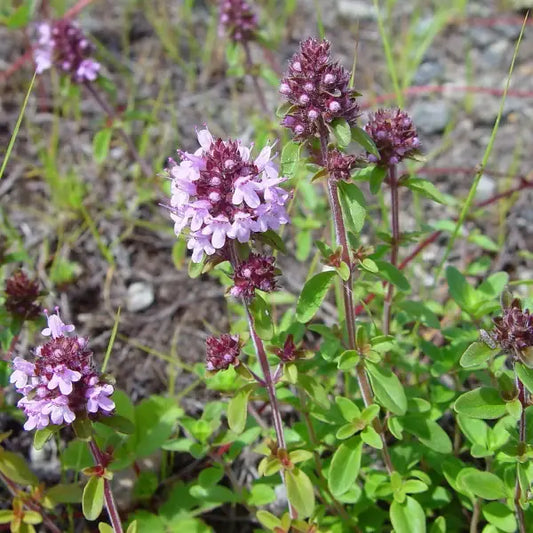
Common Thyme - Thymus vulgaris

€2,50 EUR
€6.250,00 EUR 1kg
Price plus shipping
Delivery time: 1-2 business days (PT – international may vary)
reicht für ca. 10 m²

In stock

Historical cultivated plant with wild origin – traditional, unchanged wild form. Open-pollinated & non-hybrid – 100% free from genetic engineering & synthetic fertilisers. Ecologically propagated - preserved in its original form.
Bohnensamen2

Harvest year:

2024

Seed viability:

3 years (species-specific)
Detailed information on germination capacity

Description

Cultivation & Characteristics

Common Thyme – Mediterranean culinary herb with intense aroma and versatile uses. 

Perennial, evergreen culinary herb with small, aromatic leaves and a warm‑spicy, slightly resinous flavour. Grows compactly as a low subshrub and is ideal for open ground, rock gardens, and container cultivation. Heat‑resistant, drought‑tolerant, and winter‑hardy – well suited for self‑sufficiency and ecological growing.


  Origin & History

Common thyme (Thymus vulgaris) originates from the sunny, dry landscapes of the western Mediterranean region, especially southern France, Spain, and parts of North Africa. It belongs to the family Lamiaceae, the subfamily Nepetoideae, and the genus Thymus.

As early as around 300 BC, common thyme was mentioned in Greek sources, where it was described as an aromatic incense and medicinal herb. The Romans adopted it from this tradition, spread it throughout their provinces, and used it to season cheese, wine, and meat dishes. In the Middle Ages, common thyme entered northern cultivation through monastic gardens and was also described as a medicinal plant in medical manuscripts of the 12th century. In the early modern period, it remained an important culinary herb and appeared in numerous herbals.

With Mediterranean cuisine, common thyme became a key component of classic spice blends such as “Herbes de Provence” and continues to shape dishes in southern France, Italy, and Spain. The wild form remained virtually unchanged for centuries and is valued for its robustness, intense aroma, and ability to thrive reliably even in poor, dry soils. Today, common thyme is widespread worldwide and appreciated both in cooking and in traditional herbal medicine.


  Appearance & Characteristics

The plant grows compact, bushy, and slightly woody, reaching about 15–35 cm in height and up to 40 cm in width. It carries numerous small, evergreen leaves and shows a high tolerance to drought and heat. It prefers sunny, warm locations and is winter‑hardy down to around −20 °C.

Leaf details:

  • Size: Small and narrow, individual leaflets approx. 0.5–1 cm

  • Shape: Lanceolate to linear, often slightly rolled

  • Color: Grey‑green to dark green, matte

  • Texture: Firm, slightly leathery, finely hairy

  • Flavor: Intensely spicy, warm, slightly resinous with earthy notes


 Usage & Cultivation Highlights

Common thyme is a versatile culinary herb whose fresh and dried leaves enhance a wide range of dishes. It pairs excellently with meat and braised dishes, stews, soups, sauces, as well as fish, poultry, and vegetable dishes. In Mediterranean cuisine, it shapes classic blends such as “Herbes de Provence” and harmonises particularly well with potatoes, tomatoes, courgettes, aubergines, and pulses. Common thyme flavours vinegar, oil, marinades, and barbecue seasonings and is ideal for herb mixes, herb butter, dips, pestos, and savoury baked goods. When dried, it retains its intense aroma and enriches roasts, ragouts, pasta sauces, pizza, focaccia, herb oils, herb salts, and oven dishes. It also refines mushroom dishes, risotto, lamb and game dishes, pickled vegetables, tomato confit, savoury jams, and infused honey. In beverages, it adds distinctive notes to lemonades, syrups, herbal drinks, and warm winter beverages. Its flowers serve as edible decoration and support bees and other pollinators in natural gardens. Traditionally, thyme is also used in herbal teas, infusions, inhalations, and compresses.

Common thyme grows compactly and reliably in open ground, raised beds, rock gardens, herb spirals, and in pots on balconies and terraces. It is extremely low‑maintenance, winter‑hardy, and provides aromatic foliage throughout the season. It thrives particularly well in sunny, dry locations and copes with poor, stony soils as well as nutrient‑poor potting mixes. The plant remains compact, responds very well to pruning, and regenerates quickly. Thanks to its robust nature, common thyme is ideal for urban gardening, lean substrates, and exposed sites, as it requires little water and withstands dry periods well. Its fine woody structure provides stability, while its dense growth suppresses weeds and can help stabilise light soils on slopes. As a perennial and winter‑hardy species, it is perfect for long‑term herb beds and delivers reliable harvests. In mixed culture, it pairs well with rosemary, sage, and wild strawberries. Its long flowering period offers valuable food for pollinators, and as a slug‑resistant plant, it enriches permaculture and natural gardens.

Compared to other culinary herbs, common thyme is the classic Mediterranean seasoning herb with an intense aroma — indispensable for braised dishes, barbecue blends, and sunny locations.

Cultivation_Overview_-_Anbau_im_Uberblick_-_Visao_geral_do_cultivo_-_www

Origin & Cultivation at a Glance

First mention:

300 BC

Origin:

Western and central Mediterranean region

Breeder:

Not known - historical cultivated plant

Propagation site:

Algarve - Portugal

Suitable for:

Open field, Raised bed, Balcony / pot, Urban gardening, Plant towers or tiered systems

Overwintering:

Hardy – suitable for perennial cultivation outdoors.

Special features:

Perennial / Winter green, Resilient, Low-maintenance, Sun-loving / sunny, Drought-tolerant, Heat-tolerant, Cold-hardy
benjis-seeds-plant-growing-instructions-icon

Cultivation guide for

Common Thyme

Growing difficulty:

Easy

Care requirements:

Low – easy to care for, ideal for beginners.

Mediterranes Klima

Mitteleuropäisches Klima

• In subtropical climates, sow from March to September in sunny, dry locations – pre‑cultivation is possible from January.
• In temperate regions, start pre‑cultivation from February to March – plant out frost‑free from mid‑April in full sun.
• Sowing in well‑drained, sandy‑stony and nutrient‑poor soil. Light‑dependent germinator – do not cover with soil. Plant spacing: 30 × 40 cm.

Cultivation tips:

• Pre‑cultivation is recommended – young plants develop steadily and vigorously.
• Ideal for prairie plantings and dry gardens; can be combined with Mediterranean herbs.

Storage instructions:

Store seeds in a cool, dry, dark, and airtight environment to maximize shelf life and germination.
Detailed information on seed storage
Plant_Profile_-_Pflanzen_Steckbrief_-_Ficha_da_planta_-_www

Plant Profile

Common Thyme

Plant details

Botanical name:
Thymus vulgaris L.
Botanical family:
Lamiaceae
Plant type:
Medicinal and culinary herb
Growth habit:
Upright growth, Bushy, Herbaceous, Compact, Creeping, Clump-forming
Plant width:
40 cm
Plant height:
35 cm
Root type:
Shallow-rooted
Hardy to:
-20 °C
Cultivation period:
3-5 years
Life cycle:
Perennial, long‑lived (4–7 years)

Sowing & Planting

Germination type:
Light germinator
Sowing depth:
0 cm
Germination temperature:
18-22 °C
Germination time:
10-21 days
Pot culture:
Requires a minimum container size of 1 liter.
Row spacing for baby leaf:
Not suitable for baby-leaf cultivation.
Plant spacing:
30 cm
Row spacing:
40 cm
Pricking out / thinning out:
3-4 weeks, thin out after formation of the first true leaf pairs.
Planting time:
Tomato seedlings are ready to be planted outdoors about four weeks after potting up, once temperatures are consistently warm. Plant only in consistently warm weather – ideally after the last frosts, when both daytime and nighttime temperatures are mild.

Soil

Soil type:
Well‑drained, sandy‑stony, low‑nutrient loam soil
Soil pH:
6.5-7.5 - slightly acidic to alkaline
Nutrient requirements:
Light feeder
Soil moisture:
Moderately moist, Drought tolerant, Adaptable, Sensitive to waterlogging
Soil preparation:
Loosen soil before sowing, Prepare soil weed-free and with a fine crumb structure., Low-nutrient soil recommended, Apply lime to acidic soil.

Companion planting, Crop rotation & Harvest

Companion plants:
Lavender, Rosemary, Sage, Oregano, Savory, Hyssop, Marjoram
Incompatible plants:
Moisture‑loving plants, Heavy feeder, Shade‑casting tall perennials, Rhizomatous, spreading plants
Crop rotation guidelines:
• Do not plant after other Lamiaceae - a minimum interval of 3 years is recommended.
• Remains in the same location for several years.
• Follow‑up crops should prefer nutrient‑poor soils – ideal are Mediterranean herbs and other species adapted to lean conditions.
Sowing to harvest:
2-4 months
Harvested parts:
Leaves, Shoot tips
Suitable for consumption:
Yes - edible raw or cooked.
Intended use:
Culinary herb, Cooking, Roasting, Grilling, Baking, Pickling, Tea, Drying / Dehydrating, Freezing, Preserving, Incense plant, Pollinator plant, Fragrant plant, Wild perennial, Companion perennial, Natural garden, Ointments, Tinctures, Essential oils

Care & Cultivation practices

Water requirements:
Low
Plant care techniques:
Only water lightly during the first weeks after planting out or during extended dry periods., Loosen and hoe, Maintain weed-free, Thin out
Plant protection:
No protection required
Cultivation notes:
Proven and easy to cultivate Root rot may occur in compacted soil – keep the soil loose and well‑drained. Growth depression under overfertilisation – prefers poor soil. Sensitive to waterlogging – use well-drained soil.
Propagation method:
Generative propagation by seed, Vegetative propagation, Division possible, Propagation by cuttings
Propagation:
• This variety is predominantly cross‑pollinated through insect pollination and belongs to the genus Thymus.
• For seed production, a minimum isolation distance of 800–1000 m from other varieties of the same species is recommended, as cross-pollination is easily possible.
• The plant is perennial – after flowering it produces numerous small, well‑ripening seeds in dry capsule fruits.
• The seeds are ready for harvest once the seed heads have fully dried and become slightly brittle.

Other names

EN - English names:

• Common thyme • Garden thyme

DE - German names:

• Echter Thymian • Gartenthymian

PT - Portuguese names:

• Tomilho comum

ES - Spanish names:

• Tomillo común

FR - French names:

• Thym commun

Customer Reviews

Be the first to write a review
0%
(0)
0%
(0)
0%
(0)
0%
(0)
0%
(0)

Reviews in Other Languages

Further recommendations for you

Open-pollinated and reproducible