'Escariol Grüner' Endive - Cichorium endivia

€3,00 EUR
€8.571,43 EUR 1kg
Price plus shipping
Delivery time: 1-2 business days (PT – international may vary)
reicht für ca. 150 plants

In stock

Traditional cultivar & modern classic. Open-pollinated & non-hybrid – 100% free from genetic engineering & synthetic fertilisers. Ecologically propagated – non‑proprietary variety.
Bohnensamen2

Harvest year:

2025

Seed viability:

Up to 4 years (species-specific)
Detailed information on germination capacity

Description

Cultivation & Characteristics

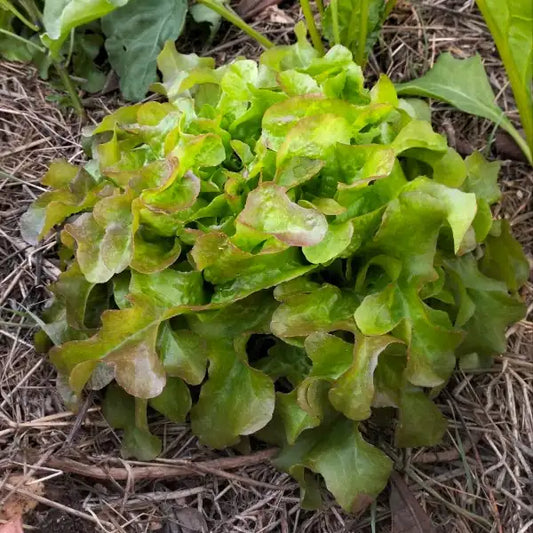
'Escariol Grüner' Endive – traditional variety with large, smooth‑edged green leaves.

This variety is a broad‑leaved endive with large, rosette‑shaped heads and fleshy, entire‑margined leaves. It has a mild, slightly nutty flavor with only few bitter compounds and convinces with its crisp texture. Robust, frost‑tolerant, and open‑pollinated – optimal for autumn and winter cultivation as well as for self‑sufficiency in ecological farming.


  Origin & History

‘Escariol Grüner’ is a proven variety within the broad‑leaved endives, distinguished by its robustness and good storability. It emerged from the long tradition of endive cultivation in the Mediterranean region, where these crops have been valued for centuries. While endives in general have been cultivated since antiquity, the variety ‘Escariol Grüner’ was documented as a distinct type only in the 20th century in seed catalogs. It was deliberately selected to create a variety with fleshy, entire‑margined leaves and a stable yellow heart, particularly suited for autumn and winter cultivation.

The variety has established itself in Europe as a reliable autumn salad and has been widespread in different regions for decades. Its particular strength lies in its ability to form stable, well‑filled heads even under cooler temperatures and moist conditions. Its distribution in European gardens and seed catalogs since the mid‑20th century shows that it belongs to the most popular types of escarole endives. To this day, it is appreciated as a classic variety, convincing with its mild, slightly nutty flavor and crisp texture.


  Appearance & Characteristics

The plant grows in a rosette form and reaches a height of about 35 cm. It develops large, well‑filled heads with fleshy, entire‑margined leaves and a yellowish heart. It shows high resistance to moisture and is frost‑tolerant down to about -5 °C.

Head details:

  • Size: Large, rosette‑growing

  • Shape: Rosette‑shaped, well‑filled

  • Color: Green with yellowish heart

  • Texture: Crisp, fleshy

  • Flavor: Mild, slightly nutty, low in bitter compounds


 Usage & Cultivation Highlights

The leaves of ‘Escariol Grüner’ are excellent for fresh use as salad. Their mild, nutty flavor with only few bitter compounds and crisp texture make them a classic in autumn and winter cuisine. They harmonize well with aromatic herbs, nuts, and strong dressings. In addition, they can be served as a fine side dish with meat and fish, where their slight bitterness provides a fresh contrast. In Mediterranean cooking, they are often briefly sautéed with olive oil and garlic or combined with legumes. They are also suitable as a filling for savory pies or quiches, as the leaves retain their structure when cooked. Thanks to their good storability after harvest, they remain fresh for a long time and can be used in pantry cooking and regional winter dishes.

With their good storability, they stay fresh and crisp after harvest. The variety grows reliably in open field, cold greenhouse, or polytunnel and shows pronounced resistance to moisture. Its uniform development allows staggered harvesting over several weeks – ideal for continuous self‑sufficiency. Moreover, ‘Escariol Grüner’ convinces with high adaptability to different sites and soils, forming stable heads even under less optimal conditions. It also withstands short dry periods. Its uniform head development and good storability make it a reliable variety for autumn and winter cultivation, valued both in home gardens and professional vegetable production.

Compared to other endive varieties, ‘Escariol Grüner’ is especially robust against moisture, frost‑tolerant, and high‑yielding – a proven open‑pollinated variety for autumn and winter cultivation.

Cultivation_Overview_-_Anbau_im_Uberblick_-_Visao_geral_do_cultivo_-_www

Origin & Cultivation at a Glance

First mention:

1942

Origin:

Mediterranean region, Central Europe

Breeder:

Not documented – traditional variety.

Propagation site:

Hesse - Germany

Suitable for:

Open field, Greenhouse, Balcony / pot, Polytunnel, Cold frame, Urban gardening, Raised bed, Vertical cultivation, Plant towers or tiered systems

Overwintering:

Possible outdoors in mild, sheltered locations

Special features:

High-yielding, Resilient, Low-maintenance, Selbstbleichend, Bolt-resistant
benjis-seeds-plant-growing-instructions-icon

Cultivation guide for

Escariol Grüner

Growing difficulty:

Easy

Care requirements:

Low – easy to care for, ideal for beginners.

Mediterranes Klima

Mitteleuropäisches Klima

Cultivation tips:

• A layer of mulch keeps the soil evenly moist and suppresses weeds.
• Loosen only the surface of the soil to avoid damaging the roots.
• Do not plant young plants too deeply; keep the centre of the plant above soil level.
• Möglichst bodennah gießen und das Pflanzenherz trocken halten.
• Für ein noch milderes Herz nur trockene, nahezu erntereife Köpfe 7–10 Tage lichtdicht abdecken.
• Gebleichte Köpfe zeitnah ernten, da sie empfindlicher gegen Fäulnis sind.

Storage instructions:

Store seeds in a cool, dry, dark, and airtight environment to maximize shelf life and germination.
Detailed information on seed storage
Plant_Profile_-_Pflanzen_Steckbrief_-_Ficha_da_planta_-_www

Plant Profile

Escariol Grüner

Plant details

Botanical name:
Cichorium endivia L. 'Escariol Grüner'
Botanical family:
Asteraceae – daisy family
Plant type:
Leafy vegetables
Growth habit:
Upright growth, Herbaceous, Forms a rosette
Plant width:
40 cm
Plant height:
35 cm
Root type:
Taprooted, Deep-rooted
Hardy to:
-4 °C - Schutz empfohlen
Cultivation period:
3-5 months
Life cycle:
Biennial

Sowing & Planting

Germination type:
Light-independent germinator
Sowing depth:
0,5-1 cm
Germination temperature:
18-22 °C
Germination time:
6-10 days
Pot culture:
Requires a minimum container size of 20-30 liters.
Row spacing for baby leaf:
Not suitable for baby-leaf cultivation.
Plant spacing:
30–40 cm
Row spacing:
30–40 cm
Pricking out / thinning out:
Thin out within 2-3 weeks after the first true leaf pairs have formed.
Planting time:
Vorgezogene Jungpflanzen können ca. 3–4 Wochen nach dem Säen ins Freiland gesetzt werden.

Soil

Soil type:
Deep, well-drained, humus-rich loam
Soil pH:
6.0-7.0 - slightly acidic to neutral
Nutrient requirements:
Medium feeder
Soil moisture:
Evenly moist, Sensitive to waterlogging
Soil preparation:
Loosen the soil deeply before planting, Prepare soil weed-free and with a fine crumb structure., Mulch layer for moisture regulation

Companion planting, Crop rotation & Harvest

Companion plants:
Dwarf beans, Leek, Brassicas, Fennel
Incompatible plants:
Crop rotation guidelines:
• Should not follow other Asteraceae crops – a 3-year rotation is advised.
Sowing to harvest:
2.5-3 months
Harvested parts:
Leaves, Heads
Suitable for consumption:
Yes - edible raw.
Intended use:
Raw consumption, Salad, Steaming, Cooking, Roasting, Baking, Stuffing

Care & Cultivation practices

Water requirements:
Moderate
Plant care techniques:
Thin out after germination when sown directly, Water regularly - even during dry periods, Loosen and hoe, Maintain weed-free
Plant protection:
Well-ventilated location and good drainage recommended., Slug protection recommended, Mulching recommended, Frostschutz bei Dauerfrost oder angekündigten Temperaturen um -4 °C empfohlen
Cultivation notes:
Susceptible to slugs and snails in early development. Sensitive to waterlogging – use well-drained soil. Vorzeitige Blütenbildung nach längeren Kältephasen möglich.
Propagation method:
Generative propagation by seed
Propagation:
• Diese Sorte ist überwiegend selbstbefruchtend und gehört zur Art Cichorium endivia.
• For seed production, a minimum isolation distance of 150 m from other varieties of the same species is recommended.
• For seed saving, collect seeds from at least 60 healthy, true-to-type plants.
• Overwinter selected plants and allow them to flower in the second year.
• Die Samen sind erntereif, sobald die Blütenköpfe braun und trocken sind.
• Geerntete Blütenköpfe luftig nachtrocknen, Samen auslösen, reinigen und vollständig trocknen.

Other names

EN - English names:

• Endive • Escarole • Broad-leaved endive • Batavian endive

DE - German names:

• Endivie • Glatte Endivie • Breitblättrige Endivie • Eskariol • Winterendivie

PT - Portuguese names:

• Chicória escarola • Escarola

ES - Spanish names:

• Escarola • Escarola de hoja ancha

FR - French names:

• Chicorée scarole • Scarole

Customer Reviews

Be the first to write a review
0%
(0)
0%
(0)
0%
(0)
0%
(0)
0%
(0)

Reviews in Other Languages

Further recommendations for you

Open-pollinated and reproducible