'Black Kabuli' Chickpea – rare black chickpea with a nutty aroma.
Annual, warmth‑loving legume with aromatic dark brown to black seeds and a fine, nutty flavour. The plants grow compactly, reaching 40–60 cm in height, are drought‑tolerant, and ideal for sunny, warm locations. They thrive reliably outdoors and in raised beds with low water requirements. The variety is robust, easy to care for, and open‑pollinated – perfect for self‑sufficiency, dry beds, and ecological cultivation.
 Origin & History
‘Black Kabuli’ belongs to the traditional Kabuli types that have been cultivated for centuries in Afghanistan and neighbouring regions. This group of varieties is known for its light to dark, rounded seeds and its mild, nutty flavour. As an old landrace, ‘Black Kabuli’ was preserved over generations through farmer selection and adapted to dry, stony soils. Botanically, it belongs to the family Fabaceae, subfamily Faboideae, and the genus Cicer.
The earliest known mention of a dark Kabuli type appears in a Persian agricultural text from the 17th century, describing “black‑seeded Kabuli chickpeas from the mountains of Kabul.” This historical note is considered the first written reference to a variety clearly corresponding to today’s ‘Black Kabuli’. Such dark Kabuli forms were traditionally grown in higher, arid regions, where they were valued for their robustness and aromatic flavour.
Over the centuries, Kabuli types spread along trade routes into Central Asia and the Mediterranean, where dark variants like ‘Black Kabuli’ were used especially for refined dishes, soups, and pastes. Their drought resistance and ability to produce reliably even in poor soils made them an important crop in arid areas. In some regions, they were considered particularly wholesome and used for simple home remedies such as warming soups or strengthening pastes served during exhaustion or in winter. The variety survived as a regional landrace and is still appreciated today for its distinctive aroma and its decorative dark seeds.
 Appearance & Characteristics
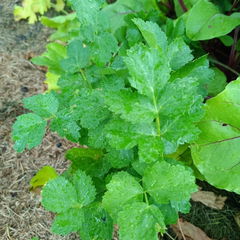
‘Black Kabuli’ chickpea is an annual, bushy‑herbaceous plant that forms upright, lightly branched shoots with pinnate, grey‑green leaves. The white pea‑flowers appear from early summer and are visited by wild bees. After flowering, short, inflated pods develop, each containing 1–2 dark seeds. The strong taproot reaches 40–100 cm deep, enabling the plant to withstand dry periods well.
Plant details:
Height: Medium, 40–60 cm
Form: Upright, bushy, herbaceous, compact
Leaves: Pinnate, grey‑green
Flowers: Violet
- Seeds: Black, rounded
Flavor: Mild‑nutty, finely aromatic
 Usage & Cultivation Highlights
‘Black Kabuli’ is excellent for curries, stews, salads, hummus, falafel, roasted snacks, and long‑term storage. The seeds can be dried, cooked, pickled, fermented, or processed into flour. Their nutty aroma makes them highly versatile – from savoury to sweet. They are also suitable for creamy spreads, protein‑rich soups, Middle Eastern rice dishes, crispy oven roasts, and as a base for plant‑based burger patties. The flour of the dark seeds is traditionally used for flatbreads, pancakes, and pastries, giving dishes a warm colour and a fine roasted flavour. The variety also shows its quality in bowls, warm mezze dishes, and as a fibre‑rich side.
In cultivation, ‘Black Kabuli’ proves extremely robust: it prefers sunny, warm locations and well‑drained, sandy‑stony soils. Thanks to its deep taproot, it copes very well with drought and requires only minimal watering. Waterlogging should be avoided. The plants are easy to care for, low in disease pressure, and thrive reliably even in poor soils. As a legume, it fixes nitrogen and improves long‑term soil fertility. It also shows remarkable stability during heat periods. Its short growing season allows reliable ripening even in regions with shorter summers, and the plants remain sturdy and productive even under adverse conditions.
Compared to other chickpeas, ‘Black Kabuli’ stands out with its decorative dark seeds, fine flavour, and high adaptability – ideal for self‑sufficiency, dry beds, natural gardens, and ecological cultivation.