Common Mugwort - Artemisia vulgaris

€2,50 EUR
Save {price}%
€8.333,33 EUR kg
Price plus shipping
Delivery time: 1-2 business days (PT – international may vary)
reicht für ca. 5 m²

In stock

Historic, traditional and unchanged wild form. Genetically stable & open-pollinated - 100% free from hybrid breeding, GMOs, and synthetic fertilizers. Organically propagated - preserved in its original form.

Local pickup at Benjis Seeds

Bohnensamen2

Harvest year:

2024

Seed viability:

40 years (species-specific)
Detailed information on germination capacity

Description

Cultivation & Characteristics

Tips & Reviews

Common Mugwort traditional aromatic wild perennial with a spicy fragrance and versatile uses. 

Perennial, robust wild herb with aromatic leaves that are dark green on the upper side and silvery‑white beneath. It grows vigorously, is winter‑hardy, and well suited to open ground, naturalistic gardens and wild‑herb beds. It germinates reliably and forms long‑lived, persistent clumps. Ideal for self‑sufficiency, incense use and ecological wild‑herb cultivation.


  Origin & History

Common mugwort is one of the oldest cultivated and wild plants of Eurasia. Its original range includes the temperate regions of Europe and Asia, extending into North Africa. It belongs to the daisy family (Asteraceae), the subfamily Asteroideae, and the genus Artemisia, whose name is traditionally associated with the goddess Artemis.

As early as antiquity, mugwort was described as an aromatic medicinal and ritual plant, for example by Dioscorides and Hippocrates. In Germanic and Celtic traditions it was regarded as a protective herb and burned during solstice celebrations. In the Middle Ages it was an important monastic‑garden plant and was referred to as the “mother of herbs”.

For centuries mugwort has been used as a seasoning for rich dishes such as goose or pork, as its bitter compounds and essential oils aid digestion. Its characteristic aroma is created by compounds such as thujone and cineole. Thanks to its adaptability, it spread along paths and settlements and became a typical companion plant of human habitats. Its long history as a culinary, medicinal and incense plant makes it a defining traditional wild perennial of Europe to this day.


   Appearance & Characteristics

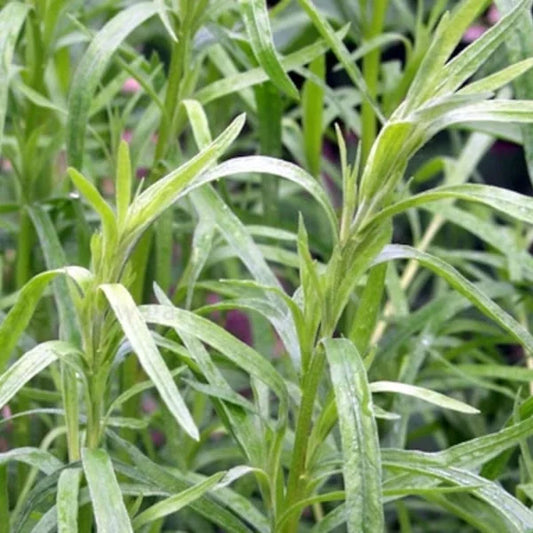
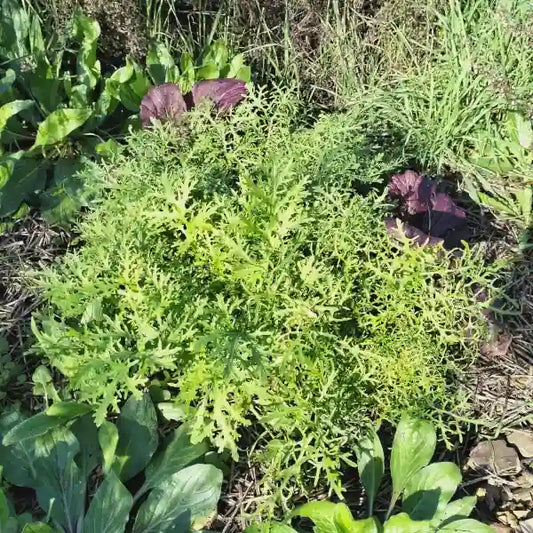
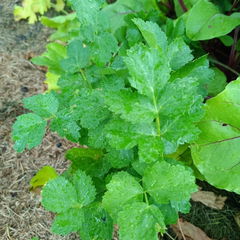
The plant is perennial and herbaceous, producing upright, sturdy stems. The leaves are deeply lobed, dark green on the upper side and silvery‑white and hairy beneath. The small yellowish‑brown flowers appear from late summer in dense, panicle‑like inflorescences. It forms a strong, vigorously spreading rhizome. Hardy to at least −34 °C.

Plant details:

  • Height: Medium to tall, 100–150 cm

  • Form: Upright, bushy, strongly branched

  • Leaves: Deeply lobed, silvery‑white on the underside

  • Flowers: Yellowish‑brown, in panicles

  • Flavor: Spicy‑bitter, aromatic


 Usage & Cultivation Highlights

Common mugwort is ideal as a seasoning for rich dishes, roast goose, stews and game. Its aromatic, slightly bitter flavour enhances herb salt, spice blends and traditional culinary herbs. The dried leaves and flower heads are used for incense, tea and cultural rituals. In many regions of Europe and Asia, mugwort has traditionally been used to support general well‑being, for example for digestive comfort or to promote relaxation. It is also used in herb bundles, scented cushions, as a component of incense mixtures and in craft applications such as herbal wreaths. In folk tradition it is regarded as a classic protective and seasonal herb that was burned during festivals and rites of passage. Its aromatic shoots are also suitable for flavouring vinegar, oils and traditional beverages.

Common mugwort thrives reliably in open ground, along paths and in naturalistic gardens. The plant is extremely low‑maintenance, winter‑hardy and can be harvested for many years. Its flowers attract numerous beneficial insects and support ecological balance in the garden. Thanks to its robust nature, it continues to grow steadily even in poor, dry soils, regenerates quickly after each cut and can be harvested multiple times. It forms long‑lived, spreading clumps, is excellent for wild‑herb beds and shows strong tolerance to drought, heat and fluctuating weather conditions. It also copes well with nutrient‑poor sites, remains vigorous in full sun and exposed, windy locations, and is ideally suited to ecological cultivation and low‑maintenance garden concepts due to its resilience.

Compared with other Artemisia species, common mugwort is the classic traditional wild plant with particularly versatile uses – ideal for anyone who values easy‑care, perennial wild herbs with high cultural significance and strong benefits for insects.

Cultivation_Overview_-_Anbau_im_Uberblick_-_Visao_geral_do_cultivo_-_www

Origin & Cultivation at a Glance

First mention:

9th century

Origin:

Europe to East Asia

Breeder:

Wild form – taken into cultivation unchanged

Propagation site:

Lower Saxony – Germany

Suitable for:

Open field, Raised bed, Balcony / pot, Urban gardening, Rock garden

Care requirements:

Low – easy to care for, ideal for beginners.

Overwintering:

Hardy – suitable for perennial cultivation outdoors.

Special features:

Perennial, Resilient, Low-maintenance, High-yielding, Sun-loving / sunny, Shade-tolerant / partial shade, Drought-tolerant, Heat-tolerant, Cold-hardy
Plant_Growing_Instructions_-_Pflanzen_Anbau-Anleitung_-_Instrucoes_de_cultivo_de_plantas_-_www

Cultivation guide for

<tc>Common Mugwort</tc>

Growing difficulty:

Easy
In subtropical climates, sow outdoors from March to September in a sunny to partially shaded spot – pre‑cultivation is not recommended.
In temperate regions, direct sowing from April to June after the last frost in full sun – pre‑cultivation not recommended.
Sowing in well‑drained, sandy‑stony and nutrient‑poor loam. Light‑dependent germinator – do not cover with soil. Plant spacing: 40 × 50 cm.

Cultivation tips:

Direct sowing is recommended – young plants grow stable and vigorous.
Thin out early so the plants have enough space.
Good air circulation protects against aphids and fungal diseases.
Fertilize sparingly - overly nutrient-rich soils reduce the aroma.
Ideal for prairie plantings and dry gardens; can be combined with Mediterranean herbs.
Biochar and rock dust improve soil structure and enhance the retention of nutrients and water.

Storage instructions:

Store seeds in a cool, dry, dark, and airtight environment to maximize shelf life and germination.
Detailed information on seed storage
Plant_Profile_-_Pflanzen_Steckbrief_-_Ficha_da_planta_-_www

Plant Profile

Plant details

Botanical name:

<tc>Artemisia vulgaris L.</tc>

Botanical family:

Asteraceae

Plant type:

Medicinal and culinary herb

Life cycle:

Perennial, long‑lived (5–10+ years)

Cultivation period:

3-5 years

Growth habit:

Upright growth, Herbaceous, Bushy, Clump-forming

Plant width:

60 cm

Plant height:

100–150 cm

Root type:

Shallow to moderately rooted

Hardy to:

-34 °C

Cultural meaning:

Historical, Traditional

Suitability for cultivation and use:

Summer crop, Fall crop, Peak season, Year-round crop, Self-sufficiency, Biodiversity, Variety conservation, Educational projects / School garden, Fresh consumption, Processing

Propagation method:

Generative propagation by seed, Vegetative propagation, Division possible in spring, Rhizome-forming, Self-seeding

Propagation:

This variety is cross‑pollinating through wind pollination and belongs to the genus Artemisia.
For seed production, a minimum isolation distance of 800–1000 m from other varieties of the same species is recommended, as cross-pollination is easily possible.
The plant is perennial – after flowering it produces numerous small, well‑ripening seeds in dry aggregate achenes.
The seeds are ready for harvest once the seed heads have fully dried and become slightly brittle.

Sowing & Planting

Germination type:

Light germinator, Temperate germinator

Sowing depth:

0 cm

Germination temperature:

15-20 °C

Germination time:

10-20 days

Pot culture:

Suitable from a pot volume of 7 litres.

Row spacing for baby leaf:

Not suitable for baby-leaf cultivation.

Plant spacing:

40 cm

Row spacing:

50 cm

Pricking out / thinning out:

No thinning required – direct sowing recommended.

Planting time:

Transplanting not required - direct sowing is recommended.

Soil

Soil type:

Well‑drained, sandy‑stony, low‑nutrient loam soil

Soil pH:

6.0-7.0 - slightly acidic to neutral

Nutrient requirements:

Weak‑ to moderate feeder

Soil moisture:

Intermittently moist, Drought-tolerant, Adaptable, Sensitive to waterlogging

Soil preparation:

Loosen soil before sowing, Prepare soil weed-free and with a fine crumb structure., Low-nutrient soil recommended

Companion planting, Crop rotation & Harvest

Companion plants:

Thymus species, Oregano, Sage, Rosemary, Lavender, Hyssop, Savory, Chamomile, Yarrow, Onion crops

Incompatible plants:

Heavy feeder, Root vegetable, Leafy vegetable, Moisture‑loving plants, Nightshade family, Clover, Legumes, Cucurbits

Crop rotation guidelines:

Should not follow other Asteraceae crops – a 3-year rotation is advised.
Perennial – remains in the same location for several years.
Follow‑up crops should prefer nutrient‑poor soils – ideal are Mediterranean herbs and other species adapted to lean conditions.

Harvest time:

Spring, Summer, Autumn

Sowing to harvest:

2-4 months

Harvested parts:

Young leaves, Shoot tips, Flower buds, Flower head (curd), Roots

Suitable for consumption:

Yes - edible raw or cooked.

Intended use:

Culinary herb, Tea, Drying / Dehydrating, Incense plant, Wild perennial, Companion perennial, Natural garden, Tinctures, Ointments, Essential oils, Decoration

Care & Cultivation practices

Water requirements:

Low to moderate

Plant care techniques:

Thin out after germination when sown directly, Irrigate occasionally, Loosen and hoe, Maintain weed-free

Plant protection:

No protection required

Cultivation notes:

Proven and easy to cultivate Susceptible to slugs and snails in early development. At a later stage, the hardier leaves are less vulnerable. Root rot may occur in compacted soil – keep the soil loose and well‑drained. Growth depression under overfertilisation – prefers poor soil. Sensitive to waterlogging – use well-drained soil.

Other names

EN - English names:

Common mugwortMugwortFelon herbSailor’s tobacco

DE - German names:

Beifuß Gemeiner BeifußWilder BeifußJungfernkraut

PT - Portuguese names:

Artemísia

ES - Spanish names:

Artemisa

FR - French names:

Armoise commune
Practical_Planting_and_Care_Tips_-_Praktische_Aussaat-_und_Pflegetipps_-_Dicas_praticas_de_sementeira_e_cuidados_-_www

Practical sowing and care tips

Saattiefe - Bedingt Keimverhalten und Gesundheit

Sowing depth - Determines germination and health

Germination rate too low or plants bending over? Decisive factors for sowing depth. In this article from my gardening handbook,...
Read more here
Aussaat-Arten - Direktsaat und Vorkultivierung

Sowing methods - direct sowing and pre-cultivation

How do I sow seeds: direct sowing or pre-cultivation? In this article, we'll explain the background of both methods, along...
Read more here
Keimarten und Umgebungsfaktoren - Wie Samen keimen

Germination types and environmental factors - How seeds germinate

Which germination types are relevant, and what should you consider when germinating seeds? In this article, we've compiled a simple,...
Read more here
Mulch - Wasser sparen und Wachstum fördern

Mulching - save water and promote growth

Nature as a model - mulching has numerous advantages that benefit the health of soil life and plants. In this...
Read more here

Customer Reviews

Be the first to write a review
0%
(0)
0%
(0)
0%
(0)
0%
(0)
0%
(0)

Further recommendations for you

100% open-pollinated & reproducible