'Dyna' Kohlrabi - Brassica oleracea var. gongylodes

<tc>'Dyna' Kohlrabi - Brassica oleracea var. gongylodes</tc>
€3,50 EUR
Save {price}% Sold out
€7.000,00 EUR kg
Price plus shipping
Delivery time: 1-2 business days (PT – international may vary)
reicht für ca. 100 plants

In stock

Traditional cultivation method & heirloom variety. Genetically stable & open-pollinated - 100% free from hybrid breeding, GMOs, and synthetic fertilizers. Organically propagated - Non-proprietary variety.

Local pickup at Benjis Seeds

Bohnensamen2

Harvest year:

2024

Seed viability:

Up to 4 years (species-specific)
Detailed information on germination capacity

Description

Cultivation & Characteristics

Tips & Reviews

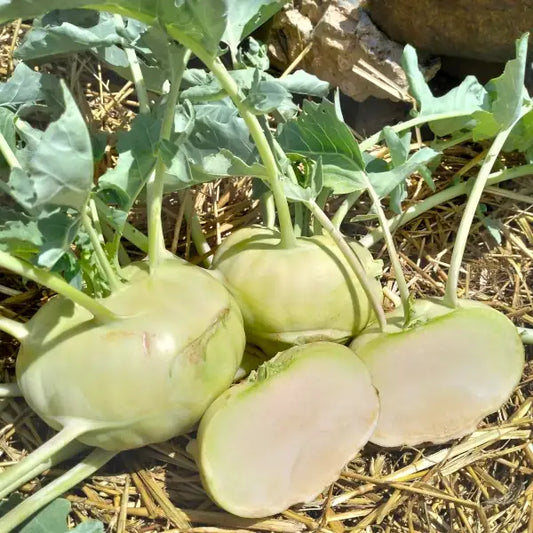
'DynaKohlrabi – old autumn variety with large, light-blue bulbs. 

Extraordinary large kohlrabi with light-blue bulbs up to 1.5 kg. Non-woody, mild-tender and juicy taste. Frost-tolerant, storable, suitable for outdoor and greenhouse cultivation. Robust, high-yielding, open-pollinated – ideal for self-sufficiency and organic growing.


  Origin & History

'Dyna' is an open-pollinated, historical autumn variety of kohlrabi (Brassica oleracea var. gongylodes). Traditionally bred as a large-growing, light-blue variety for late autumn cultivation at the "Ekkarthof" in Siegershausen (Canton of Thurgau, Switzerland). It was long popular in Central Europe before modern hybrids displaced it and it nearly fell into oblivion. Its exceptionally large bulbs, weighing over 1 kg, remain tender and juicy without becoming woody.

The variety is well suited and highly valued as an autumn and storage kohlrabi. Kohlrabi has been part of traditional Central European vegetables since the 16th century, originating from wild cabbage in the Mediterranean region. With its mild-tender, juicy flavor and vigorous growth, it is considered an old variety and a true enrichment for heritage gardens. Today it is once again cultivated by organic seed initiatives and preserved as a historical rarity.


  Appearance & Characteristics

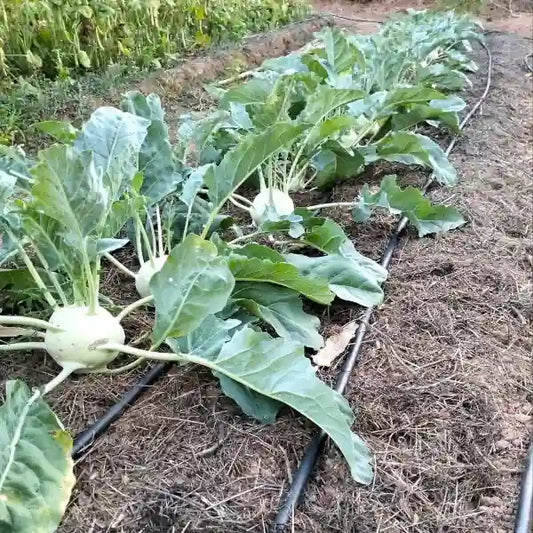
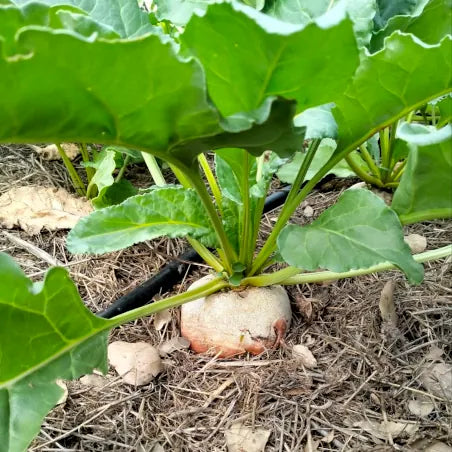
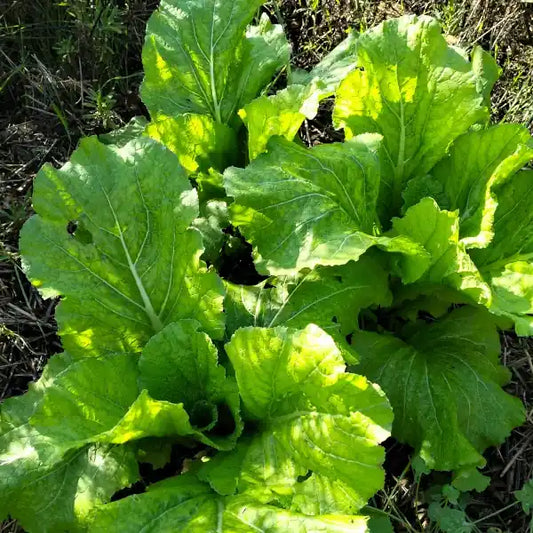
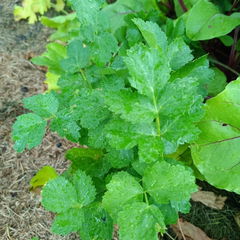
The plant grows vigorously, upright, and reaches a height of about 40 cm. It forms numerous light-green leaf stalks and bears strong, dark-green foliage. Frost-tolerant down to -5 °C.

Bulb details:

  • Size: Very large, 1 kg per bulb, sometimes up to 1.5 kg

  • Shape: Round to slightly flattened, about 10–15 cm in diameter

  • Color: Light blue with light-green flesh

  • Texture: Juicy, tender, non-woody

  • Flavor: Mild, tender and very juicy


 Usage & Cultivation Highlights

The bulbs are excellent for fresh consumption, cooking, steaming, frying, and especially for raw salads. Their mild-tender, juicy flavor and the extraordinary light-blue color with light-green flesh make them a real eye-catcher in vegetable dishes and add a special fresh note to meals. The kohlrabi leaves can also be harvested and used.

Thanks to its vigorous growth and frost tolerance, 'Dyna' grows reliably in greenhouses, in open fields, and especially in larger pots. It is easy to care for and impresses with a generous harvest. In addition, it shows good adaptability to different locations and delivers stable yields even under changeable weather conditions. Its decorative, light-blue bulbs ripen evenly and also make the plant a visual enrichment in the garden.

Compared to other kohlrabi varieties, 'Dyna' is particularly large-growing and frost-tolerant – ideal for anyone who values open-pollinated kohlrabi with exceptional size and flavor.

Cultivation_Overview_-_Anbau_im_Uberblick_-_Visao_geral_do_cultivo_-_www

Origin & Cultivation at a Glance

First mention:

20th century

Breeder:

Not clearly documented

Origin:

Switzerland

Propagation site:

Alentejo - Portugal

Suitable for:

Open field, Greenhouse, Polytunnel, Cold frame, Balcony / pot, Urban gardening, Raised bed, Vertical cultivation, Plant towers or tiered systems

Care requirements:

Low – easy to care for, ideal for beginners.

Overwintering:

Semi-hardy - tolerates short periods of light frost down to about -5 °C outdoors.

Suitability for cultivation and use:

Fall crop, Late-season cultivation, Peak season, Self-sufficiency, Biodiversity, Variety conservation, Educational projects / School garden, Direct marketing, Fresh consumption, Processing, Storage vegetables
Plant_Growing_Instructions_-_Pflanzen_Anbau-Anleitung_-_Instrucoes_de_cultivo_de_plantas_-_www

Cultivation guide for

Dyna

Growing difficulty:

Easy
In subtropical climates pre-cultivation is possible from August or January - transplant to full sun from October or March.
In temperate regions pre-cultivation is possible from March - transplant to sunny to semi-shaded locations from mid-May after frost.
Sowing in deep, well-drained, humus-rich and nutrient-rich loamy soil - 0.5-1 cm deep. Plant spacing: 35 × 40 cm.

Special features:

Quickly usable, High-yielding, Resilient, Low-maintenance, Sun-loving / sunny, Cold-hardy, Bolt-resistant

Cultivation tips:

Keep evenly moist - drought stress leads to bolting.
For a staggered harvest, it’s recommended to sow seeds in intervals of 4 weeks.
Good air circulation protects against aphids and fungal diseases.

Storage instructions:

Store seeds in a cool, dry, dark, and airtight environment to maximize shelf life and germination.
Detailed information on seed storage
Plant_Profile_-_Pflanzen_Steckbrief_-_Ficha_da_planta_-_www

Plant Profile

Plant details

Botanical name:

<tc>Brassica oleracea L. var. gongylodes L. ‚Dyna‘</tc>

Growth habit:

Upright growth, Compact growth with a rounded root, Herbaceous

Botanical family:

Brassicaceae

Plant height:

40 cm

Plant type:

Brassica vegetables

Plant width:

40 cm

Life cycle:

Biennial (grown as an annual)

Root type:

Shallow to moderately rooted

Cultivation period:

2,5-3 months

Hardy to:

-5 °C temporarily possible.

Cultural meaning:

Historical, Traditional

Propagation method:

Generative propagation by seed

Propagation:

This variety is insect-pollinated and cross-fertile, belonging to the species Brassica oleracea.
For seed production, a minimum isolation distance of 800–1000 m from other varieties of the same species is recommended, as cross-pollination is easily possible.
The plant is biennial - after flowering it produces long pods with well-maturing small seeds.
Seeds are ready for harvest once the pods are fully dried and slightly opened.

Sowing & Planting

Sowing

Planting

Germination type:

Dark germinator, Temperate germinator

Pot culture:

Requires a minimum container size of 8 liters.

Sowing depth:

0,5-1 cm

Plant spacing:

35 cm

Germination temperature:

15-20 °C

Row spacing:

40 cm

Germination time:

5-10 days

Row spacing for baby leaf:

Not suitable for baby-leaf cultivation.

Pricking out / thinning out:

3-4 weeks, thin out after formation of the first true leaf pairs.

Planting time:

Tomato seedlings are ready to be planted outdoors about four weeks after potting up, once temperatures are consistently warm. Only once the soil is frost-free

Soil

Soil type:

Deep, well-drained loamy soil rich in humus

Soil pH:

6.0-7.0 - slightly acidic to neutral

Nutrient requirements:

Medium feeder

Soil moisture:

Evenly moist, Adaptable, Sensitive to waterlogging

Soil preparation:

Loosen soil deeply before sowing, Apply compost before planting., Apply lime to acidic soil., Prepare soil weed-free and with a fine crumb structure., Consistent moisture and neutral pH soil promote root development., Mulch layer for moisture regulation

Companion planting, Crop rotation & Harvest

Companion plants:

Lettuce, Spinach, Bean, Pea, Onion crops, Celery, Potato, Dill, Chamomile, Mint

Incompatible plants:

Brassicas, Tomato, Pepper / Chili pepper, Eggplant, Strawberry, Radish, Radish varieties, Corn, Rapeseed, Sunflower, Parsley

Crop rotation guidelines:

Do not plant after other crucifers - at least 3 years interval recommended.
Repeated cultivation at the same site increases disease pressure, leads to nutrient depletion, and impairs soil structure.
Ideal previous crops include legumes, onions, root vegetables, and green manure – rotating crops supports healthy soil.
Crop rotation with low-nutrient-demanding plants is recommended to prevent soil fatigue and maintain healthy growing conditions.
Plan a green manure crop between heavy-feeding plants and this tomato variety to restore soil fertility.
Avoid planting directly after heavy-feeding crops – allow the soil to recover and replenish nutrients first.

Harvest time:

Autumn, Spring

Sowing to harvest:

2.5-3 months

Harvested parts:

Tubers

Suitable for consumption:

Yes - edible raw or cooked.

Intended use:

Diet cuisine, Low Carb, Raw consumption, Salad, Steaming, Cooking, Roasting, Grilling, Baking, Deep-frying, Stuffing, Pickling, Fermentation, To purée, Juice / juicing, Smoothies, Freezing, Preserving, Drying / Dehydrating

Care & Cultivation practices

Water requirements:

High

Plant care techniques:

Water regularly - even during dry periods, Maintain weed-free, Inspect regularly for pest infestation

Plant protection:

Well-ventilated location and good drainage recommended., Slug protection recommended, Check early for aphids., Vegetable protection net advisable., Mulching recommended

Cultivation notes:

Susceptible to slugs and snails in early development. At a later stage, the hardier leaves are less vulnerable. Can be infested by aphids - occasional monitoring recommended. Sensitive to waterlogging – use well-drained soil.

Other names

EN - English names:

Kohlrabi

DE - German names:

Kohlrabi

PT - Portuguese names:

Couve-rábano

ES - Spanish names:

Colirrábano

FR - French names:

Chou-rave
Practical_Planting_and_Care_Tips_-_Praktische_Aussaat-_und_Pflegetipps_-_Dicas_praticas_de_sementeira_e_cuidados_-_www

Practical sowing and care tips

Saattiefe - Bedingt Keimverhalten und Gesundheit

Sowing depth - Determines germination and health

Germination rate too low or plants bending over? Decisive factors for sowing depth. In this article from my gardening handbook,...
Read more here
Aussaat-Arten - Direktsaat und Vorkultivierung

Sowing methods - direct sowing and pre-cultivation

How do I sow seeds: direct sowing or pre-cultivation? In this article, we'll explain the background of both methods, along...
Read more here
Keimarten und Umgebungsfaktoren - Wie Samen keimen

Germination types and environmental factors - How seeds germinate

Which germination types are relevant, and what should you consider when germinating seeds? In this article, we've compiled a simple,...
Read more here
Mulch - Wasser sparen und Wachstum fördern

Mulching - save water and promote growth

Nature as a model - mulching has numerous advantages that benefit the health of soil life and plants. In this...
Read more here

Customer Reviews

Be the first to write a review
0%
(0)
0%
(0)
0%
(0)
0%
(0)
0%
(0)

Further recommendations for you

100% open-pollinated & reproducible