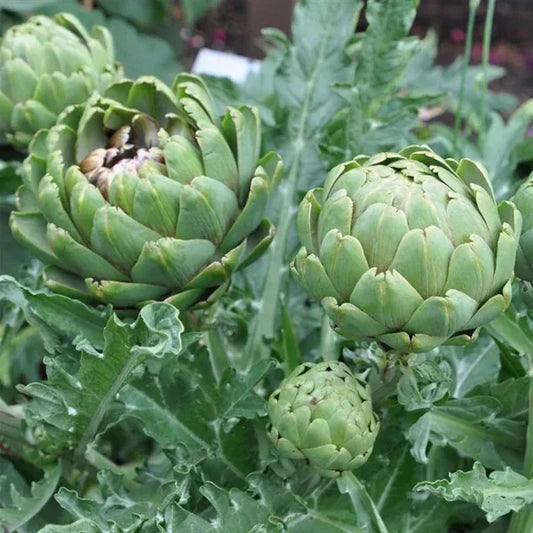
Artichoke ‘Green Globe’ – a traditional variety with large, aromatic flower buds.
This open-pollinated globe artichoke produces rounded green buds with fleshy hearts and a pleasantly aromatic flavour. Its vigorous plants combine a generous vegetable harvest with striking silvery-green foliage. In suitable locations, the variety can be cropped for several years; heads left to flower also add distinctive purple accents to the garden.
 Origin & History
‘Green Globe’ is a historic artichoke variety with a cultivation tradition dating back to the late 18th century. Its seed was already being offered in Baltimore in 1825, and it also appeared in American seed catalogues in 1828. This shows that it was established as a named variety in the North American seed trade by the early 19th century.
By the mid-19th century, ‘Green Globe’ was also widely grown in England. A detailed varietal description from 1863 highlighted its very large, almost round buds, inward-curving bracts and particularly fleshy flower base. Its substantial, aromatic edible parts were highly valued, and the variety was recommended for the main harvest. These historical descriptions therefore already emphasised the characteristics that continue to define its value as a globe artichoke today.
By the late 19th century, ‘Green Globe’ played an important role in the development of commercial artichoke production in California. From San Mateo, cultivation expanded along the coast towards Santa Cruz and into the Monterey and Castroville area. There it was grown as a perennial crop and traditionally propagated from root divisions. The cool, humid coastal climate favoured this method of cultivation and made the variety an important part of regional vegetable production.
In historical English-language varietal descriptions, ‘Green Globe’ was also listed as ‘Large Round-headed’ and ‘Globe’. Today, it is also known by the name ‘Vert Globe’. Alongside traditionally vegetatively propagated stocks, the variety is also maintained in open-pollinated seed lines. By selecting plants that remain true to type, its characteristic rounded heads and fleshy flower bases are preserved through seed saving.
 Appearance & Characteristics
The plant develops a broad rosette of large, deeply divided, grey-green leaves. Above this rise strong, branching flower stems that usually reach around 150 cm and, under favourable conditions, up to around 170 cm in height. In addition to the larger terminal bud, smaller side buds develop and can be harvested in succession. The variety is moderately winter-hardy; in frost-prone locations, young plants in particular need winter protection and a well-drained root zone.
Bud & flower details:
Size: Large main buds around 8–12 cm in diameter; side buds are usually smaller
Shape: Rounded to spherical, with tightly overlapping bracts
Colour: Green, sometimes with a slight purple tinge; open flowers are purple
Texture: Fleshy flower base and fleshy bract bases, tender after cooking
Flavour: Mild and aromatic, with a slightly sweet note
 Usage & Cultivation Highlights
The closed buds are particularly suitable for boiling and steaming. On larger heads, the fleshy bases of the bracts and the heart are eaten, while the fibrous ‘choke’ above the heart is removed. The aromatic hearts can also be stuffed, grilled or marinated as antipasti. For storage, prepared hearts can be frozen. Fully opened flower heads can be used in cut and dried arrangements and add a striking ornamental feature to the productive garden.
One of the advantages of ‘Green Globe’ is its combination of vigorous bud production and perennial cropping. Once a well-established stand has developed, it can continue to produce harvests for several years. With early propagation and suitably cool spring conditions, a first bud harvest may be possible in the sowing year; with later sowing or if flower initiation does not occur, harvesting often begins in the following year. In regions with hot summers, an adequate water supply during bud development and a protective mulch layer help maintain harvest quality. Some unharvested heads can be left to flower, providing pollen and nectar for bees and other pollinators.
Compared with varieties such as ‘Violet de Provence’, ‘Green Globe’ develops large, rounded and predominantly green buds with substantial fleshy hearts. This makes it particularly suitable for cooking whole heads and using the fleshy hearts. Its perennial cropping potential and vigorous growth make it a good choice for spacious vegetable beds where winters are mild or plants can be given protection.