Artichoke 'Green Globe' - Cynara cardunculus var. scolymus

€3,00 EUR
€2.857,14 EUR 1kg
Price plus shipping
Delivery time: 1-2 business days (PT – international may vary)
reicht für ca. 20 plants

In stock

Historische Sorte. Open-pollinated & non-hybrid – 100% free from genetic engineering & synthetic fertilisers. Ecologically propagated – non‑proprietary variety.
Bohnensamen2

Harvest year:

2024

Seed viability:

Up to 4 years (species-specific)
Detailed information on germination capacity

Description

Cultivation & Characteristics

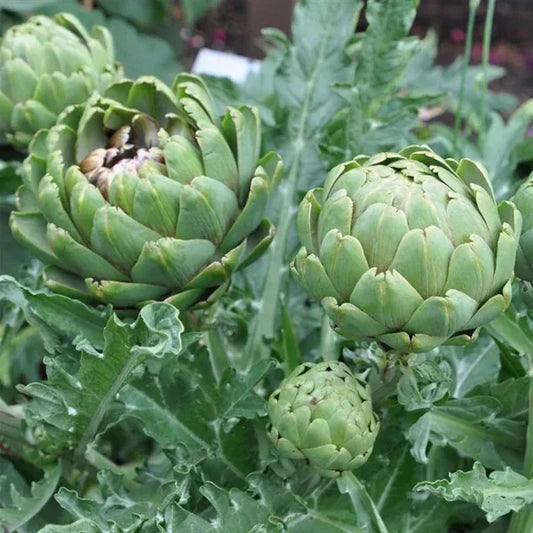
Artichoke ‘Green Globe’ – a traditional variety with large, aromatic flower buds.

This open-pollinated globe artichoke produces rounded green buds with fleshy hearts and a pleasantly aromatic flavour. Its vigorous plants combine a generous vegetable harvest with striking silvery-green foliage. In suitable locations, the variety can be cropped for several years; heads left to flower also add distinctive purple accents to the garden.

  Origin & History

‘Green Globe’ is a historic artichoke variety with a cultivation tradition dating back to the late 18th century. Its seed was already being offered in Baltimore in 1825, and it also appeared in American seed catalogues in 1828. This shows that it was established as a named variety in the North American seed trade by the early 19th century.

By the mid-19th century, ‘Green Globe’ was also widely grown in England. A detailed varietal description from 1863 highlighted its very large, almost round buds, inward-curving bracts and particularly fleshy flower base. Its substantial, aromatic edible parts were highly valued, and the variety was recommended for the main harvest. These historical descriptions therefore already emphasised the characteristics that continue to define its value as a globe artichoke today.

By the late 19th century, ‘Green Globe’ played an important role in the development of commercial artichoke production in California. From San Mateo, cultivation expanded along the coast towards Santa Cruz and into the Monterey and Castroville area. There it was grown as a perennial crop and traditionally propagated from root divisions. The cool, humid coastal climate favoured this method of cultivation and made the variety an important part of regional vegetable production.

In historical English-language varietal descriptions, ‘Green Globe’ was also listed as ‘Large Round-headed’ and ‘Globe’. Today, it is also known by the name ‘Vert Globe’. Alongside traditionally vegetatively propagated stocks, the variety is also maintained in open-pollinated seed lines. By selecting plants that remain true to type, its characteristic rounded heads and fleshy flower bases are preserved through seed saving.

 Appearance & Characteristics

The plant develops a broad rosette of large, deeply divided, grey-green leaves. Above this rise strong, branching flower stems that usually reach around 150 cm and, under favourable conditions, up to around 170 cm in height. In addition to the larger terminal bud, smaller side buds develop and can be harvested in succession. The variety is moderately winter-hardy; in frost-prone locations, young plants in particular need winter protection and a well-drained root zone.

Bud & flower details:

  • Size: Large main buds around 8–12 cm in diameter; side buds are usually smaller

  • Shape: Rounded to spherical, with tightly overlapping bracts

  • Colour: Green, sometimes with a slight purple tinge; open flowers are purple

  • Texture: Fleshy flower base and fleshy bract bases, tender after cooking

  • Flavour: Mild and aromatic, with a slightly sweet note

 Usage & Cultivation Highlights

The closed buds are particularly suitable for boiling and steaming. On larger heads, the fleshy bases of the bracts and the heart are eaten, while the fibrous ‘choke’ above the heart is removed. The aromatic hearts can also be stuffed, grilled or marinated as antipasti. For storage, prepared hearts can be frozen. Fully opened flower heads can be used in cut and dried arrangements and add a striking ornamental feature to the productive garden.

One of the advantages of ‘Green Globe’ is its combination of vigorous bud production and perennial cropping. Once a well-established stand has developed, it can continue to produce harvests for several years. With early propagation and suitably cool spring conditions, a first bud harvest may be possible in the sowing year; with later sowing or if flower initiation does not occur, harvesting often begins in the following year. In regions with hot summers, an adequate water supply during bud development and a protective mulch layer help maintain harvest quality. Some unharvested heads can be left to flower, providing pollen and nectar for bees and other pollinators.

Compared with varieties such as ‘Violet de Provence’, ‘Green Globe’ develops large, rounded and predominantly green buds with substantial fleshy hearts. This makes it particularly suitable for cooking whole heads and using the fleshy hearts. Its perennial cropping potential and vigorous growth make it a good choice for spacious vegetable beds where winters are mild or plants can be given protection.

Cultivation_Overview_-_Anbau_im_Uberblick_-_Visao_geral_do_cultivo_-_www

Origin & Cultivation at a Glance

First mention:

18th century

Origin:

Nicht bekannt

Breeder:

Unknown – heritage variety

Propagation site:

Alentejo - Portugal

Suitable for:

Open field, Raised bed, Balcony / pot

Care requirements:

Medium – requires some attention.

Overwintering:

Winterhart - mehrjährig kultivierbar im Freiland, bei starkem Frost schützen.

Special features:

High-yielding, Sun-loving / sunny, Low-maintenance, Heat-tolerant, Cold-hardy
Plant_Growing_Instructions_-_Pflanzen_Anbau-Anleitung_-_Instrucoes_de_cultivo_de_plantas_-_www

Cultivation guide for

Artischocke 'Green Globe'

Growing difficulty:

Easy
• Im subtropischen Klima Vorkultur ab August oder Januar möglich - sonnig und frostfrei auspflanzen von Oktober bis November oder März bis April.
• In temperate regions, pre‑cultivation possible from February - transplant from mid‑May frost‑free.
• Aussaat in tiefgründigen und durchlässigen, humusreichen und nährstoffreichen Lehmboden – 1–2 cm tief. Pflanzabstand: 100 × 100 cm.

Cultivation tips:

• Frühe Vorkultur und kühle Frühjahrsbedingungen fördern die Knospenbildung im ersten Jahr.
• Blütenknospen ernten, solange die Hüllblätter noch fest geschlossen sind.
• Gleichmäßige Bewässerung verbessert die Knospenqualität und unterstützt gesundes Pflanzenwachstum.
• Nach der Keimung hell und bei etwa 16 °C weiterkultivieren.
• Regelmäßige Ernte fördert die Bildung weiterer Blütenknospen.
• Bestände nach 4–5 Jahren durch Teilung oder Neupflanzung verjüngen.

Storage instructions:

Store seeds in a cool, dry, dark, and airtight environment to maximize shelf life and germination.
Detailed information on seed storage
Plant_Profile_-_Pflanzen_Steckbrief_-_Ficha_da_planta_-_www

Plant Profile

Plant details

Botanical name:

Cynara cardunculus L. 'Green Globe'

Botanical family:

Asteraceae

Plant type:

Blütengemüse

Growth habit:

Upright growth, Herbaceous, Forms a rosette, Clump-forming

Plant width:

100–150 cm

Plant height:

150–170 cm

Root type:

Deep-rooted, Taprooted

Hardy to:

-10 °C - Schutz empfohlen

Cultivation period:

3-5 years

Life cycle:

Mehrjährig, ausdauernd (15 Jahre und länger möglich)

Propagation method:

Generative propagation by seed, Division possible

Propagation:

• Diese Sorte wird durch Insekten bestäubt und gehört zur Art Cynara cardunculus.
• Zur Saatgutgewinnung empfiehlt sich ein Mindestabstand von 250–800 m zu anderen Sorten derselben Art, da Kreuzungen leicht möglich sind.
• Für die Weitervermehrung Saatgut von 20–50 gesunden, sortentypischen Pflanzen gewinnen.
• Seeds are ready for harvest once the seed heads are fully dried and slightly brittle.
• Geerntete Blütenköpfe luftig nachtrocknen, Samen auslösen, reinigen und vollständig trocken.

Sowing & Planting

Germination type:

Lichtunabhängiger Keimer

Sowing depth:

1-2 cm

Germination temperature:

18-22 °C

Germination time:

10-20 days

Pot culture:

Not recommended - better grown in garden beds or raised beds.

Row spacing for baby leaf:

Not suitable for baby-leaf cultivation.

Plant spacing:

100 cm

Row spacing:

90-100 cm

Pricking out / thinning out:

3-4 weeks, thin out after formation of the first true leaf pairs.

Planting time:

Vorgezogene Jungpflanzen können ca. 5 Wochen nach dem säen ins Freiland gesetzt werden.

Soil

Soil type:

Deep, well-drained, humus-rich loam

Soil pH:

6.5–8.0 – neutral to alkaline

Nutrient requirements:

Moderate to heavy feeder

Soil moisture:

Evenly moist, Sensitive to waterlogging

Soil preparation:

Loosen the soil deeply before planting, Apply compost before planting., Mulch layer for moisture regulation

Companion planting, Crop rotation & Harvest

Companion plants:

Lettuce, Fennel, Pak Choi, Rucola, Pea

Incompatible plants:

Celery, Onion crops

Crop rotation guidelines:

• Perennial – remains in the same location for several years.
• Mindestens 4 Jahre Anbaupause vor erneuter Pflanzung derselben Art.

Harvest time:

Subtropisch: Winter bis Frühjahr - Gemäßigt: Sommer bis Frühherbst

Sowing to harvest:

4–6 Monate bei früher Vorkultur; sonst Ernte im zweiten Jahr

Harvested parts:

Geschlossene Blütenknospen – Blütenböden und fleischige Hüllblattbasen

Suitable for consumption:

Yes - edible when cooked.

Intended use:

Steaming, Cooking, Grilling, Baking, Stuffing, Pickling, Deep-frying, Decoration

Care & Cultivation practices

Water requirements:

Moderate to high

Plant care techniques:

Water regularly - even during dry periods, Loosen and hoe, Fertilize, Maintain weed-free

Plant protection:

Slug protection recommended, Mulching recommended, Well-ventilated location and good drainage recommended.

Cultivation notes:

Susceptible to slugs and snails in early development. Can be infested by aphids - occasional monitoring recommended. Sensitive to waterlogging – use well-drained soil.

Other names

EN - English names:

• Artichoke • Globe artichoke

DE - German names:

• Artischocke • Gemüseartischocke

PT - Portuguese names:

• Alcachofra

ES - Spanish names:

• Alcachofa • Alcaucil

FR - French names:

• Artichaut

Customer Reviews

Be the first to write a review
0%
(0)
0%
(0)
0%
(0)
0%
(0)
0%
(0)

Reviews in Other Languages

Further recommendations for you

Open-pollinated and reproducible
Es gibt noch keine Produkte!