Celeriac ‘Monarch’ – traditional storage variety with large, white-fleshed roots.
This open-pollinated celeriac variety produces large, heavy roots with firm, white flesh and a pleasantly mild, slightly nutty celery flavour. The flesh retains its light colour when cooked and is equally suitable for delicate raw salads, flavoursome soups, purées and fried celeriac slices. Its good storage qualities provide a versatile supply of vegetables for the colder months. In addition to the roots, the aromatic leaves can also be used to add flavour to stocks and vegetable dishes. With a reliable water supply, the variety is suitable for Mediterranean regions as well as for the long outdoor growing season in Central European climates.
 Origin & History
‘Monarch’ was bred by Walter Hild in Marbach am Neckar, Germany, and has been known since the 1970s. The variety became established in European commercial vegetable production and was grown both for the fresh market and for processing. Its large roots, high proportion of light-coloured flesh and mild flavour were particularly valued. These characteristics made it suitable for the production of dried and pickled celeriac products as well as for the sale of fresh roots. By the end of the 1990s, ‘Monarch’ already accounted for more than half of the European celeriac market.
As the variety became more widespread, milder, pale-fleshed celeriac gained importance compared with older, more strongly flavoured types. Around the turn of the millennium, ‘Monarch’ was also among the standard varieties used in German variety trials. The variety therefore combines a long history of use in professional vegetable production with characteristics that are also valued in home gardens. Its substantial roots and good suitability for storage have earned it an established place among proven autumn and storage celeriac varieties. To this day, it continues to be maintained as an open-pollinated variety alongside newer cultivars and propagated in organic vegetable production.
 Appearance & Characteristics
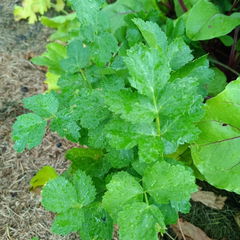
The plants develop a vigorous rosette of upright to slightly spreading, dark green, distinctly divided leaves. While grown for its root, the foliage usually reaches around 40–60 cm in height. The pale roots sit partly above the soil surface and develop numerous lateral roots on their underside. In the second year, overwintered plants can produce branched flower stalks up to around 150 cm tall, bearing small, whitish flowers in umbels. Mature plants tolerate light frost, but the roots should be harvested or protected before severe or prolonged frost. Young plants are sensitive to prolonged cold, which can trigger premature flowering.
Root details:
Size: Very large, around 10–15 cm in diameter
Shape: Rounded to trapezoidal, sometimes slightly flattened
Colour: Pale beige to grey-brown skin and white flesh
Texture: Firm and juicy, crisp when raw and tender when cooked
Flavour: Mild, slightly nutty and pleasantly aromatic with a characteristic celery flavour
 Usage & Cultivation Highlights
The roots can be finely grated for raw salads and classic celeriac remoulade. Cooked, they add flavour to soups, stews and stocks, can be made into a creamy purée or sliced, fried and breaded. Their mild, nutty flavour also works well in roasted vegetable dishes and gratins. The aromatic leaves can be used sparingly to flavour vegetable stocks. For longer-term storage, the roots can be stored in cool, humid conditions, while prepared pieces can be blanched and frozen or thinly sliced and dried.
The high individual yield of its large roots makes ‘Monarch’ particularly suitable for self-sufficiency and autumn harvesting. The roots can be harvested while still smaller or left to develop further for a larger yield. This gives the variety flexibility between earlier use and fully mature roots for storage. Its good keeping quality extends the supply well beyond the main gardening season. The pale flesh, which has little tendency to discolour, also remains well suited to a range of preparation methods.
Compared with other celeriac varieties, ‘Monarch’ stands out for its large, heavy roots, mild, slightly nutty flavour and pale flesh that retains its light colour when cooked. Its good storage qualities make it particularly suitable for autumn harvesting and for maintaining a supply of fresh vegetables through winter.