New Zealand Spinach - Tetragonia tetragonioides

€2,50 EUR
€625,00 EUR kg
Price plus shipping
Delivery time: 1-2 business days (PT – international may vary)
reicht für ca. 10 m²

In stock

Historical crop plant with wild origin – traditional cultivation form. Genetically stable & open-pollinated - 100% free from hybrid breeding, GMOs, and synthetic fertilizers. Organically propagated – free, open-pollinated cultivated plant.

Local pickup at Benjis Seeds

Bohnensamen2

Harvest year:

2023

Seed viability:

5 years (species-specific)
Detailed information on germination capacity

Description

Cultivation & Characteristics

New Zealand Spinach – warm‑loving summer leaf vegetable with fleshy, mild leaves.

It is a warm‑loving, annual leafy vegetable with fleshy, triangular leaves and a mild, slightly salty flavor. It grows creeping as a ground cover, is extremely heat‑tolerant, and is ideally suited for open field, greenhouse, and pot cultivation. Robust, high‑yielding, and true‑to‑seed – perfect for self‑sufficiency and organic farming.


  Origin & History

New Zealand Spinach originates from the coastal regions of Australia, New Zealand, South America, and East Asia. It grows wild on sandy soils, dunes, and salt marshes, and thanks to its succulent leaves it is particularly tolerant of salinity. The plant was first described in 1770 during Captain James Cook’s first Pacific voyage and introduced to England by his naturalist Sir Joseph Banks. There it established itself as a summer vegetable, since unlike the heat‑sensitive garden spinach (Spinacia oleracea) it thrives reliably even at high temperatures.

In Europe and North America, New Zealand spinach became increasingly cultivated in the late 18th and early 19th centuries and entered kitchen gardens under names such as “Cook’s Cabbage” or “Botany Bay Greens.” It was especially valued for its high vitamin C content, making it a useful antiscorbutic for seafarers.

Botanically, New Zealand Spinach belongs to the ice plant family (Aizoaceae) and is not related to true spinach. Nevertheless, because of its similar culinary use and its mild, slightly salty flavor, it is cultivated as a spinach alternative.


  Appearance & Characteristics

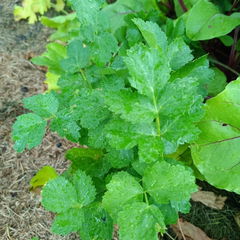
The plant grows creeping as a ground cover and can spread up to 120 cm. It produces numerous fleshy, triangular to rhomboid leaves on branched shoots. Extremely heat‑tolerant and drought‑resistant. In mild climates it can persist longer, but it does not withstand frost.

Leaf details:

  • Size: Medium, approx. 5-10 cm long leaves

  • Shape: Triangular to rhomboid, fleshy and succulent‑like

  • Color: Medium to dark green, glossy

  • Texture: Fleshy, juicy, slightly crisp

  • Flavor: Mild, slightly salty, spinach‑like


 Usage & Cultivation Highlights

The leaves are excellent for fresh consumption in salads, smoothies, and as garnish. Their mild, slightly salty flavor makes them a popular spinach alternative in summer cuisine. They can also be briefly steamed, blanched, or lightly sautéed as a warm side dish, fit well into soups and stews, and add a fine note to green pestos or herb spreads. As part of diet and low‑carb cooking they are appreciated for being nutrient‑rich and low in calories. In modern cuisine they are used in wraps, bowls, quiches, and omelets, while traditionally they were valued as a vitamin‑rich addition to summer diets. The young shoot tips are especially tender and aromatic.

Thanks to its creeping growth and heat tolerance, New Zealand Spinach grows reliably outdoors, in greenhouses, and even in larger pots or raised beds. The species is very easy to care for, requires only moderate watering, and delivers stable yields over a long period even at high temperatures. Particularly noteworthy is the continuous harvest, as the plant produces new shoots after cutting. Its salt and drought tolerance make it ideal for sandy or light soils as well as coastal regions. It also thrives in full sun and can be used as a ground cover to suppress weeds.

Compared to true spinach, New Zealand Spinach is significantly more heat‑tolerant and grows throughout the summer – ideal for anyone seeking open‑pollinated leafy greens with reliable growth and mild flavor for the warm months.

Cultivation_Overview_-_Anbau_im_Uberblick_-_Visao_geral_do_cultivo_-_www

Origin & Cultivation at a Glance

First mention:

1770

Origin:

Coastal regions of New Zealand, Australia, East Asia, and South America (Chile, Peru)

Breeder:

Unknown – heritage variety

Propagation site:

Lower Saxony – Germany

Suitable for:

Open field, Greenhouse, Polytunnel, Balcony / pot, Urban gardening, Raised bed, Plant towers or tiered systems

Care requirements:

Low – easy to care for, ideal for beginners.

Overwintering:

Not hardy – longer growing season in mild temperatures.

Special features:

Annual variety / Fast-growing, High-yielding, Resilient, Low-maintenance, Sun-loving / sunny, Heat-tolerant, Drought-tolerant
Plant_Growing_Instructions_-_Pflanzen_Anbau-Anleitung_-_Instrucoes_de_cultivo_de_plantas_-_www

Cultivation guide for

Neuseeländer Spinat

Growing difficulty:

Easy
In subtropical climates sow directly outdoors from March to September in full sun – pre-culture not recommended.
In temperate regions sow in full sun from mid-May after frost – pre-culture possible from March.
Sowing in well-drained, sandy-humus-rich and moderately nutrient-rich loamy soil – 3-4 cm deep. Plant spacing: 40 × 50 cm.
For baby leaf, sow densely with row spacing of 10-15 cm.

Cultivation tips:

Direct sowing is recommended – young plants grow stable and vigorous.
Thin out early so the plants have enough space.
Water regularly - consistent moisture promotes tender leaves and mild flavor.
Do not cut the plant completely down to the ground, but only harvest the upper shoots. This way it will sprout again and allow for multiple harvests throughout the season.
Regular harvesting encourages new fruit set and increases overall yield.

Storage instructions:

Store seeds in a cool, dry, dark, and airtight environment to maximize shelf life and germination.
Detailed information on seed storage
Plant_Profile_-_Pflanzen_Steckbrief_-_Ficha_da_planta_-_www

Plant Profile

Plant details

Botanical name:

<tc>Tetragonia tetragonioides (Pall.) Kuntze</tc>

Botanical family:

Aizoaceae

Plant type:

Leafy vegetables

Growth habit:

Prostrate, mat‑forming growth, Creeping, Herbaceous

Plant width:

60-120 cm – mat-forming

Plant height:

40 cm

Root type:

Shallow to moderately rooted

Hardy to:

3 °C - protection strongly recommended below 0 °C.

Cultivation period:

8-10 months

Life cycle:

Annual

Propagation method:

Generative propagation by seed, Self-seeding

Propagation:

This variety is cross-pollinated by insects and belongs to the species Tetragonia tetragonioides.
For seed production, a minimum isolation distance of 800–1000 m from other varieties of the same species is recommended, as cross-pollination is easily possible.
The plant is annual – after flowering it produces small, branched inflorescences with numerous, small, well‑ripening seeds.
The seeds are ready for harvest once the seed heads have completely dried and become straw‑like and brittle.

Sowing & Planting

Germination type:

Dark germinator, Temperate germinator

Sowing depth:

3-4 cm

Germination temperature:

15-24 °C

Germination time:

14-21 days

Pot culture:

Requires a minimum container size of 10-15 liters.

Row spacing for baby leaf:

10-15 cm

Plant spacing:

40 cm

Row spacing:

50 cm

Pricking out / thinning out:

No thinning required – direct sowing recommended.

Planting time:

Transplanting not required - direct sowing is recommended.

Soil

Soil type:

Well-drained, humus-rich sandy loam soil

Soil pH:

6.0-7.5 – slightly acidic to alkaline

Nutrient requirements:

Medium feeder

Soil moisture:

Evenly moist, Adaptable, Sensitive to waterlogging

Soil preparation:

Loosen soil before sowing, Apply compost before planting., Prepare soil weed-free and with a fine crumb structure., Mulch layer for moisture regulation

Companion planting, Crop rotation & Harvest

Companion plants:

Lettuce, Brassicas, Pea, Bean, Carrot, Onion crops, Corn, Dill, Coriander, Basil

Incompatible plants:

Chard, Celery, Cucurbits, Nightshade family, Beetroot, Sugar beet

Crop rotation guidelines:

Repeated cultivation at the same site increases disease pressure, leads to nutrient depletion, and impairs soil structure.
Avoid planting directly after heavy-feeding crops – allow the soil to recover and replenish nutrients first.
Ideal previous crops include legumes, onions, root vegetables, and green manure – rotating crops supports healthy soil.
Crop rotation with low-nutrient-demanding plants is recommended to prevent soil fatigue and maintain healthy growing conditions.

Harvest time:

Spring, Summer, Autumn, Winter

Sowing to harvest:

2-3 months

Harvested parts:

Leaves

Suitable for consumption:

Yes - edible raw or cooked.

Intended use:

Diet cuisine, Low Carb, Raw consumption, Salad, Steaming, Cooking, Roasting, Freezing, To purée, Smoothies

Care & Cultivation practices

Water requirements:

Moderate

Plant care techniques:

Thin out after germination when sown directly, Water regularly - even during dry periods, Maintain weed-free

Plant protection:

Mulching recommended

Cultivation notes:

Proven and easy to cultivate Susceptible to slugs and snails in early development. At a later stage, the hardier leaves are less vulnerable. Sensitive to waterlogging – use well-drained soil.

Other names

EN - English names:

New Zealand spinach

DE - German names:

Neuseeländer Spinat

PT - Portuguese names:

Espinafre-da-Nova Zelândia

ES - Spanish names:

Espinaca de Nueva Zelanda

FR - French names:

TétragoneÉpinard de Nouvelle-Zélande

Customer Reviews

Be the first to write a review
0%
(0)
0%
(0)
0%
(0)
0%
(0)
0%
(0)

Further recommendations for you

100% open-pollinated & reproducible