Red Pointed Cabbage ‘Kalibos’ – rare red-purple pointed cabbage from the Czech Republic with tender heads for eating raw.
This open-pollinated red cabbage variety combines striking pointed heads with tender, juicy leaves and a pleasantly mild, sweet flavour. The red-purple heads have a small internal stem and are particularly well suited to finely shredded raw salads. Whether steamed, briefly fried or fermented into pink sauerkraut, the variety also brings versatility to cooked dishes. In Mediterranean climates, cultivation during the milder growing periods is recommended, while in Central European climates the variety is particularly suitable for summer and autumn harvesting.
 Origin & History
‘Kalibos’ originates from the Czech Republic and was developed by Moravoseed from the regional red cabbage variety ‘Vysocké’. It therefore traces its origins to a Czech landrace from which a distinct open-pollinated variety was developed. Its characteristic feature is the combination of a pointed head shape with exceptionally tender, red-purple leaves. By 1997 at the latest, ‘Kalibos’ was also known outside the Czech Republic, and the following year it was entered in the Czech national variety register. Its origins link the variety to the old regional diversity of red cabbage, while it subsequently became established as a distinct variety in the European seed trade.
One of the traditional uses of ‘Kalibos’ is lactic fermentation to produce pink sauerkraut. Its mild, sweet leaves are also valued for salads. This gives the variety a different range of uses from many particularly firm red cabbages bred for long-term storage. Today, ‘Kalibos’ is grown both in home gardens and in organic vegetable production and continues to be propagated as an open-pollinated variety. Its upward-pointing heads and tender leaf structure remain the defining characteristics of this Czech speciality.
 Appearance & Characteristics
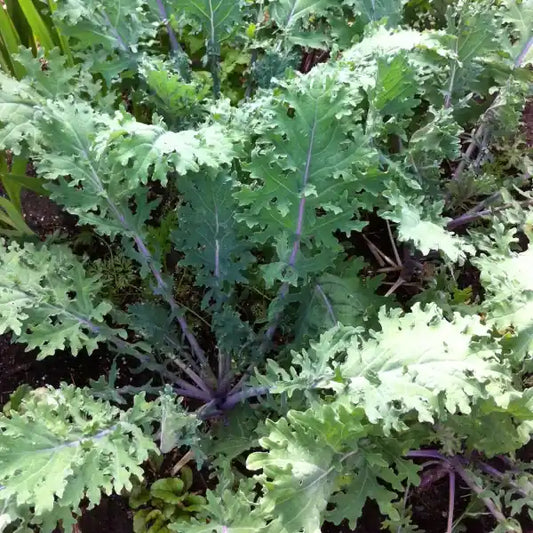
The plants grow upright and form a spreading rosette of broad, red-purple to blue-purple leaves with a slightly waxy coating. At the usual harvesting stage, they generally reach around 40–60 cm in height. An elongated, distinctly pointed head develops from the centre, with leaves that are less densely packed than those of many traditional red cabbage varieties bred for storage. The outer stem can become comparatively long. The plants tolerate light frost, but the heads should be harvested or protected before severe or prolonged frost. Plants overwintered for seed production develop branched flower stalks with yellow flowers in their second year.
Head details:
Size: Medium to large, around 1.5–2.5 kg per head
Shape: Elongated to conical, distinctly pointed at the top
Color: Red-purple to purplish red, with pale leaf veins when cut
Texture: Tender, juicy and fine-leaved, pleasantly crisp when raw
Flavor: Mild, sweet and delicately cabbage-like
 Usage & Cultivation Highlights
The tender leaves are particularly suitable for finely shredded raw salads and colourful coleslaws. Lightly steamed, stir-fried or braised as red cabbage, they retain a pleasant bite when cooked gently. The heads are also suitable for stuffing, pickling and fermenting. Lactic fermentation produces a striking pink sauerkraut. For longer-term storage, the cabbage can also be blanched and frozen in portions. Its strengths lie in fresh preparation and preserving through processing, rather than storing whole heads for several months.
In cultivation, ‘Kalibos’ has comparatively good resistance to splitting, so mature heads do not need to be harvested immediately. The medium to large heads provide a generous yield while remaining practical for processing in manageable portions at home. Staggered planting allows the harvest of fresh cabbage to be spread over a longer period. Its tolerance of light autumn frosts extends the harvesting season beyond the warmer months without restricting the variety to winter cultivation.
Compared with many round-headed red cabbage varieties, ‘Kalibos’ stands out for its pointed heads, tender leaf structure and mild, sweet flavour. It is particularly suitable for eating raw and for dishes requiring only brief cooking, while very firm storage varieties of red cabbage are better suited to keeping whole heads for extended periods.