Wood Avens - Herb Bennet – traditional wild perennial with an aromatic root and versatile uses.
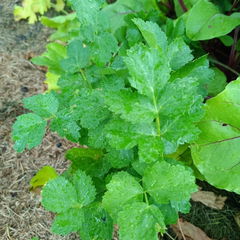
A robust, perennial wild plant with a characteristically clove‑scented root. Its growth is tufted, compact and rosette‑forming, with upright, delicate flowering stems. The plants grow reliably, form long‑lived clumps and are ideal for natural gardens, woodland plantings, medicinal beds and ecological borders. Hardy, open‑pollinated and traditionally used as an aromatic plant, medicinal herb and wild vegetable.
 Origin & History
Wood Avens (Geum urbanum) is an open‑pollinated wild perennial native to the temperate regions of Europe and Western Asia. It has been part of the European flora since antiquity, favouring light woodlands, woodland edges, hedgerows and humus‑rich, semi‑shaded sites. Its hooked aggregate achenes cling to animal fur, enabling its wide natural dispersal along wildlife corridors. Botanically, it belongs to the family Rosaceae, subfamily Rosoideae, genus Geum.**
Wood Avens is mentioned in the 9th‑century Carolingian “Capitulare de villis”, where it appears as an important medicinal and culinary plant for monastic and royal gardens. In the 11th century it reappears in the widely circulated medieval herbal “Macer floridus”, which describes its aromatic root and strengthening properties. Hildegard of Bingen refers to it in the 12th century as a warming, fortifying plant that “strengthens heart and stomach”. In the early modern period it is listed in European herbals such as those of Pietro Andrea Mattioli (1554) and John Gerard (1597) as a proven medicinal and aromatic herb.
Historically, the root of Wood Avens was valued for its intense clove‑like scent — an aroma produced by its eugenol content. It was used to flavour beer, wine and food, and in folk medicine it was regarded as warming, strengthening, digestive and mildly antiseptic. In traditional herbal practice it was used for digestive and intestinal complaints, mouth and throat inflammations, fever, exhaustion and for strengthening during convalescence. The dried root was incorporated into tea blends, tinctures and bitter preparations, while the leaves served as a mild wild vegetable. In incense traditions it was used as a cleansing herb with a warm, aromatic fragrance.
Today, Wood Avens remains a valued wild perennial in naturalistic plantings, woodland gardens and herb beds. Its robustness, subtle aroma and ecological importance make it a long‑established plant deeply rooted in both cultural history and natural landscapes.
 Appearance & Characteristics
The plants form compact, ground‑level rosettes and develop upright, delicate flowering stems with yellow blooms in spring. The short, branched rhizome produces long‑lived clumps and ensures regular new growth. Hardy down to –30 °C.
Plant details:
Height: Medium, 30–60 cm tall, 20–35 cm wide
Form: Rosette‑forming, tufted, upright‑flowering
Flower colour: Yellow
Flowering period: May to September
Scent: Root with an intense clove aroma
 Usage & Cultivation Highlights
Wood Avens is traditionally used for teas, tinctures, herbal blends and as an aromatic plant. The root imparts a warm, clove‑like aroma to dishes, bitters and incense mixtures, and was historically used to flavour beer and wine. Young leaves serve as a mild wild vegetable in salads or gently cooked herb dishes. The dried root is suitable for digestive and herbal teas, oil infusions, warming herbal wines and aromatic bitters. In folk medicine it was used for digestive discomfort, exhaustion, fever and convalescence. It also plays a role in traditional incense practices, where its warm scent is considered cleansing and harmonising. As a wild and medicinal plant, it is valuable for natural gardens, woodland gardens and ecological plantings, supporting pollinators and forming long‑lived, stable clumps.
Wood Avens is robust and easy to grow. It thrives in semi‑shaded to shaded areas, prefers humus‑rich, slightly moist soils and benefits from leaf mulch similar to its natural woodland habitat. It is well suited to the cool, moist spectrum of the subtropics. The plants are winter‑hardy, regenerate reliably and propagate through self‑seeding or division. Thanks to its compact growth, it is excellent for mixed plantings, underplanting and naturalistic borders. Its natural resilience, low maintenance requirements and ecological value make it a long‑lasting and worthwhile garden plant. It also shows high tolerance to root pressure from trees and shrubs, maintains stable growth even in poorer soils and quickly covers open ground. It remains vigorous even in changeable summers, responds positively to organic soil improvement and establishes reliably without special care.
Compared with other wild and medicinal perennials, Wood Avens stands out for its characteristic clove aroma, its robustness and its versatile uses — ideal for anyone seeking traditional, aromatic and ecologically valuable plants for shaded sites.