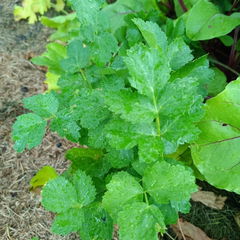
The perennial licorice is a diverse and very old culinary, tea and medicinal plant. It is known for the sweet licorice and was considered a classic remedy in Tibetan medicine. Expectorant for coughs and sore throats. Ideal for direct sowing, pot cultivation possible, sowing spring-summer, good for mixed culture, harvesting the roots, stems and leaves.
Description
Liquorice is a perennial culinary, tea and medicinal plant, also known as liquorice, which originally comes from western Asia and the Mediterranean region. This versatile traditional herbal medicine has been known in Chinese medicine since 2800 BC and was also considered a classic remedy in Tibetan medicine. The plant is known for the sweet liquorice obtained from its woody and yellow roots and has a wide range of other uses. The ancient Greeks and Romans valued it as a good expectorant for coughs and sore throats, but today it is known more as liquorice and tea. The frost-sensitive plant grows primarily in dry places, in bushes and on sandy or clay soils. Chewing the dried liquorice sticks is beneficial for dental care.
General information
Plant family: Fabaceae
Life cycle: Perennial
Days to harvest: 100 days
Plant height approx.: 150 cm
Root type: Deep rooter, runner forming
Nutrient requirements: Medium
Water requirements: Low
Winter hardiness: Up to 3°C
Location: Sunny
Soil: Permeable, humus-rich sandy loam soil
pH value: 6 to 7
Sowing and planting information
Germination type: Dark germinator
Sowing depth: 0.5-1 cm
Optimal germination temperature: 20-25 °C
Germination time: 14-40 days
Plant and row spacing: 50x50 cm
Germination ability of seeds: 3-4 years
Mixed culture
Optimal mixed culture: -
Unfavorable mixed culture: -
Sowing by climate zone
Subtropic climate (Mediterranean) (e. g. B. Portugal, Spain, Italy)
Direct sowing from March to September is recommended. The plants should ideally be in a sunny location.
Moderate climate (e. g. B. Germany, Switzerland, Poland)
Direct sowing from April to July is recommended. The plants should ideally be in a sunny location.
General recommendations
Direct sowing in rows is recommended. After germination, thin out the plants to the specified plant spacing. Pre-cultivation in pots is also advisable.
Licorice prefers a permeable, nutrient-rich, dry to moist and humus-rich sandy loam soil. Doesn't tolerate waterlogging.
Additional tips
The plants tolerate dry periods well. The roots form long underground runners. The roots are harvested from the fourth year onwards. In order to quickly obtain a fine, crumbly and permeable soil with good nutrient and water storage capacity, additional incorporation of biochar and primary rock flour is recommended.
Type of propagation
Propagation occurs via seeds or cuttings.
Plant care
On very hot days, additional watering is recommended to keep growth stable. Fertilizing is only recommended in spring.
Other names
Botanical names: Glycyrrhiza glabra
English names: Licorice
German names: Süßholz, Lakritze
Portuguese names: Alcaçuz
Spanish names: Regaliz
French names: Réglisse
Origin
Country: Portugal