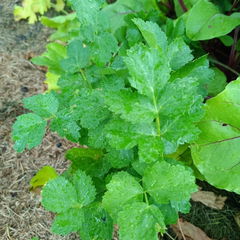
The biennial celeriac 'Monarch' is a vegetable and medicinal plant variety with large trapezoidal to round and heavy tubers. Mild and slightly nutty taste with health benefits, excellent for raw food. Long storage life. Ideal for pre-cultivation, no pot culture, sowing spring-summer, good for mixed culture, harvesting the leaves and roots.
Description
Celeriac 'Monarch' is a very old biennial vegetable and medicinal plant variety from the 17th century with origins in the Mediterranean region. In ancient Egypt it was already known as a popular vegetable, the ancient Greeks used it as a symbol of triumph and victory and generally considered it a helpful aphrodisiac. The robust variety forms very large, trapezoidal to round and heavy tubers with white and firm flesh. The taste is mild and slightly nutty, can be eaten raw and can be stored for a long time. Celeriac is a cultural and historical heritage of inestimable value and has an antibiotic, digestive, diuretic, detoxifying and nerve-calming effect.
General information
Plant family: Apiaceae
Life cycle: Biennial
Days to harvest: 180 days
Plant height approx.: 60 cm
Root type: Deep rooter
Nutrient requirements: High
Water requirements: Medium
Winter hardiness: Up to 3°C
Location: Sunny
Soil: Permeable, humus-rich sandy loam soil
pH value: 6.5 to 7.5
Sowing and planting information
Germination type: Light germinator
Sowing depth: 0 cm
Optimal germination temperature: 18-22 °C
Germination time: 10-20 days
Plant and row spacing: 40x40 cm
Germination ability of seeds: 3-4 years
Mixed culture
Optimal mixed culture: Cabbage, Kohlrabi, Lamb's lettuce, Beans, Cucumbers, Chamomile, Leek, Chard, Rocket, Spinach, Tomato, Buckwheat, Mahonia, Marjoram, Shepherd's purse, Garlic
Unfavorable mixed culture: Artichoke, Dill, Carrot, Potato, Lettuce, Corn, Pepper, Parsley
Sowing by climate zone
Subtropic climate (Mediterranean) (e. g. B. Portugal, Spain, Italy)
Pre-cultivation from February to June is recommended. The plants should ideally be placed in a sunny location.
Moderate climate (e. g. B. Germany, Switzerland, Poland)
Pre-cultivation from March to May is recommended. The plants should ideally be placed in a sunny location.
General recommendations
Direct sowing isn't recommended. For pre-cultivation, sow the seeds in a small bowl and let the seedlings grow until the first visible celery leaves appear, then transplant them into the desired container. After transplanting, let the seedlings grow at moderate temperatures until they are ready to be planted out as seedlings. Plant the seedlings in the bed from the second pair of leaves after the cotyledons.
Celeriac 'Monarch' prefers a permeable, nutrient-rich, moist and humus-rich sandy loam soil. Doesn't tolerate waterlogging.
Additional tips
When pricking out, it is important to ensure that the seedlings are not planted too deep so that tubers can form. Celery can be grown on saline soils. Roots of this variety are not sensitive to iron stains. In order to quickly obtain a fine, crumbly and permeable soil with good nutrient and water retention capacity, it is recommended to also work in biochar and primary rock flour.
Type of propagation
Propagation occurs via seeds.
Plant care
Consistent watering is important for stable growth. Fertilization is recommended after 10 weeks.
Other names
Botanical names: Apium graveolens
English names: Celeriac
German names: Knollensellerie
Portuguese names: Aipo-rábano
Spanish names: Apio nabo
French names: Céleri-rave
Origin
Country: Portugal