The annual radish 'Round Black Winter' is an almost forgotten autumn and winter radish variety with round roots weighing 300 to 500g. Fresh, spicy to hot taste. Excellent for storage and eating raw. Ideal for sowing directly, pot cultivation possible, sowing spring-summer, good for mixed culture, harvesting the roots.
Description
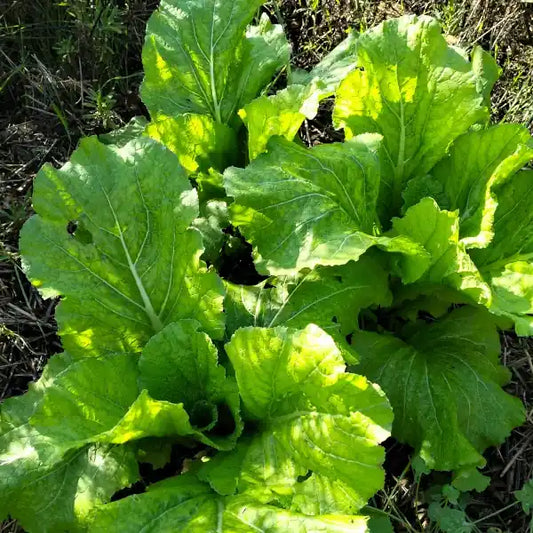
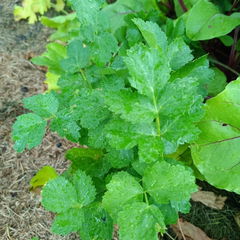
The 'Round Black Winter' radish is a very old, traditional and annual medicinal and vegetable plant variety from the 18th century. The almost forgotten autumn and winter radish develops round, turnip-shaped and dark brown to black roots, covered with a scab-like skin. The roots weigh 300 to 500 g and form a firm and pure white flesh. The robust plants grow with green, upright, pinnate and bristly hairy leaves. The winter-hardy variety has a fresh, spicy to hot taste and is ideal for eating raw. The roots can be stored for a long time and are also used to make cough syrup due to their immune-boosting properties.
General information
Plant family: Brassicaceae
Life cycle: Annual
Days to harvest: 80 days
Plant height approx.: 40 cm
Root type: Deep rooter
Nutrient requirements: Medium
Water requirements: Medium
Winter hardiness: Up to -10°C
Location: Sunny
Soil: Permeable, humus-rich loamy soil
pH value: 5.5 to 7
Sowing and planting information
Germination type: Dark germinator
Sowing depth: 1-2 cm
Optimal germination temperature: 12-20 °C
Germination time: 4-10 days
Plant and row spacing: 10x30 cm
Germination ability of seeds: 4 years
Mixed culture
Optimal mixed culture: Bean, Pea, Lettuce, Nasturtium, Chard, Parsley, Spinach, Carrot, Leek, Tomato, Salsify
Unfavorable mixed culture: Cucumber, Cabbage, Radish, Rocket, Mustard, Zucchini, Corn, Potato
Sowing by climate zone
Subtropic climate (Mediterranean) (e. g. B. Portugal, Spain, Italy)
Direct sowing is recommended from January to May and in autumn from September to December. The plants should ideally be planted in a sunny location.
Moderate climate (e. g. B. Germany, Switzerland, Poland)
Direct sowing from April to August is recommended. The plants should ideally be planted in a sunny location.
General recommendations
Due to the simple and uncomplicated germination, direct sowing in rows is recommended. Do not sow the seeds more than 1-2 cm deep so that the roots can develop. The seeds can be sown close together, and by thinning them out later, the small and too densely growing young radishes can be harvested early to give others the space they need to grow.
Winter radish 'Round Black Winter' prefers a permeable, nutrient-rich, evenly moist, sandy to humus-rich loamy soil. Doesn't tolerate waterlogging.
Additional tips
For a continuous harvest, staggered sowing every three weeks is recommended. Soil conditions determine the tuber's pungency. Calcareous, heavy, and compacted loam and clay soils are less suitable for cultivation, as they can impair tuber formation. In order to quickly obtain a fine, crumbly and permeable soil with good nutrient and water retention capacity, we recommend incorporating biochar and primary rock flour.
Type of propagation
Propagation occurs via seeds.
Plant care
Regular watering during dry periods is necessary to minimize the roots from splitting. Occasional weeding helps the young plants develop. Loosened, nutrient-rich and moist soil is sufficient. No fertilization necessary.
Other names
Botanical names: Raphanus sativus var. niger
English names: Radish, Black Spanish radish
German names: Rettich, Winter-Rettich, Langer schwarzer Pariser Rettich, Erfurter Rettich, Schwarzer Spanischer Rettich
Portuguese names: Rabanete, Rábano, Raiz-forte
Spanish names: Rábano picante
French names: Radis noir long d’été, Radis noir rond d’hiver, Radis noir long d’hiver, Raifort
Origin
Country: Germany