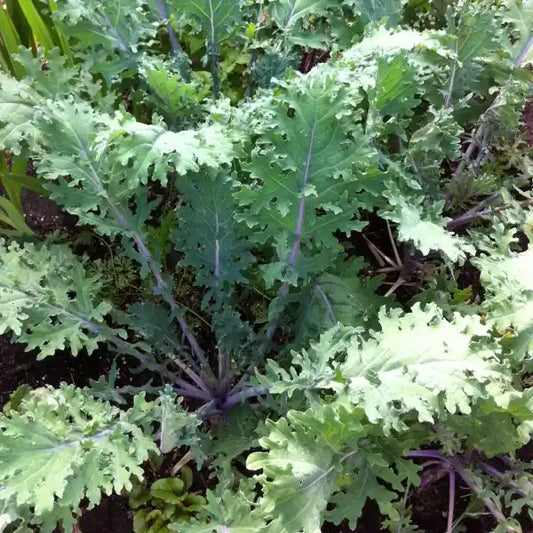
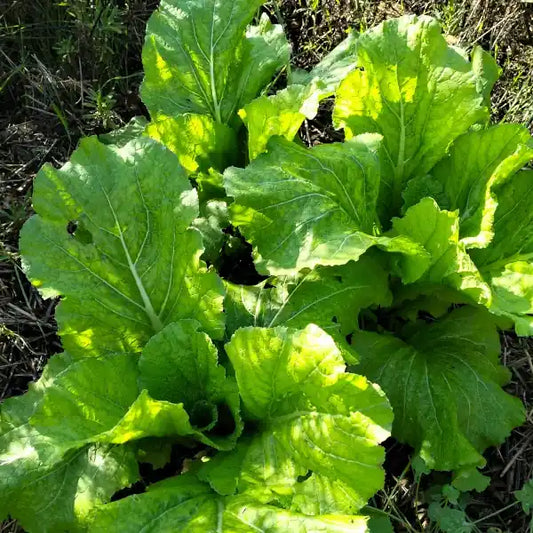
The biennial black kale 'Nero di Toscana' is a traditional, highly aromatic old cabbage specialty with a palm-like and very decorative growth. This local superfood is very rich in vitamins, tastes mild and does not require any frost before harvesting. Ideal for pre-cultivation, sowing in spring-summer, pot cultivation possible, good for mixed culture, harvesting the cabbage leaves.
Description
The black kale 'Nero di Toscana' is a biennial, highly aromatic old cabbage specialty from the 18th century with a palm-like and very decorative growth. Even back in Roman times, this vitamin-rich variety was very popular, and today it is considered a local superfood. The sun-loving palm cabbage variety has dark, blue-green leaves that roll slightly downwards and is still traditionally grown in Tuscany, northern Italy. This high-yielding variety of vegetable cabbage is mild and tastes like broccoli. Does not require frost before harvest. Well-known uses of palm cabbage are the Portuguese cabbage soup "Caldo verde" and the Tuscan "Ribollita".
General information
Plant family: Brassicaceae
Life cycle: Biennial
Days to harvest: 110 days
Plant height approx.: 100 cm
Root type: Deep rooter
Nutrient requirements: High
Water requirements: Medium
Winter hardiness: Up to -5°C
Location: Sunny
Soil: Permeable, humus-rich loamy soil
pH value: 6.5 to 7.5
Sowing and planting information
Germination type: Dark germinator
Sowing depth: 0.5-1 cm
Optimal germination temperature: 18-22 °C
Germination time: 7-14 days
Plant and row spacing: 50x50 cm
Germination ability of seeds: 5-6 years
Mixed culture
Optimal mixed culture: Basil, Marigold, Tagetes, Rosemary, Soy, Bean, Pea
Unfavorable mixed culture: Kohlrabi, Mustard, Radish, other types of cabbage
Sowing by climate zone
Subtropic climate (Mediterranean) (e. g. B. Portugal, Spain, Italy)
Pre-cultivation from January to August is recommended. The plants should ideally be planted in a sunny location.
Moderate climate (e. g. B. Germany, Switzerland, Poland)
Pre-cultivation from March to June is recommended. The plants should ideally be placed in a sunny location.
General recommendations
Pre-cultivation and subsequent planting at the specified planting distance is recommended. For pre-cultivation, sow the seeds in a small bowl and let the seedlings grow until the first visible cabbage leaves appear, then transplant them into the desired containers. After transplanting, let the seedlings grow at moderate temperatures until they are planted out as seedlings. Plant the seedlings in the bed from the second pair of leaves after the cotyledons.
Black kale 'Nero di Toscana' does not tolerate waterlogging.
Additional tips
Harvest the leaves from the outside inwards to keep growth stable. To prevent cabbage flies from laying eggs, we recommend using vegetable protection nets. To quickly obtain a fine, crumbly and permeable soil with good nutrient and water retention capacity, we recommend additionally incorporating biochar and primary rock flour.
Type of propagation
Propagation occurs via seeds.
Plant care
Loose, nutrient-rich and moist soil is essential. No fertilization necessary.
Other names
Botanical names: Brassica oleracea var. palmifolia
English names: Palm cabbage, Black kale
German names: Palmkohl, Italienischer Kohl, Toskanischer Kohl, Schwarzkohl
Portuguese names: Repolho de palma
Spanish names: Col de palma
French names: Chou de palme
Origin
Country: Portugal