'Blauhilde' Pole Bean - Phaseolus vulgaris

€3,00 EUR
€150,00 EUR kg
Price plus shipping
Delivery time: 1-2 business days (PT – international may vary)
reicht für ca. 10 m row

In stock

Traditional cultivation form & modern classic. Genetically stable & open-pollinated - 100% free from hybrid breeding, GMOs, and synthetic fertilizers. Organically propagated - Non-proprietary variety.
Bohnensamen2

Harvest year:

2022

Seed viability:

Up to 4 years (species-specific)
Detailed information on germination capacity

Description

Cultivation & Characteristics

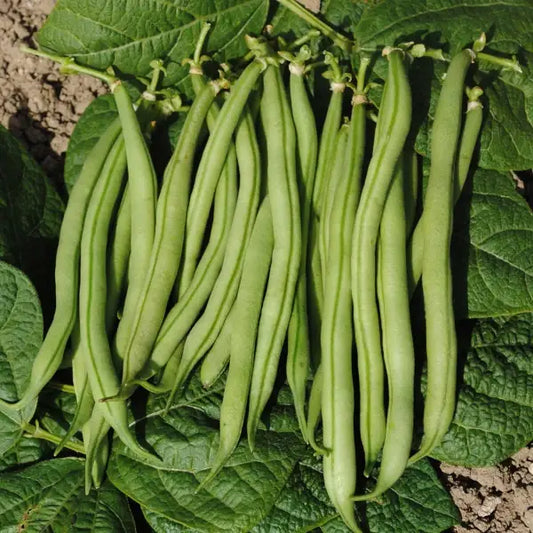
'Blauhilde' Pole Bean – traditional violet climbing bean with long, tender, stringless pods that turn green when cooked. 

Annual, warmth‑loving legume with long, violet, stringless beans and an aromatic, mildly flavoured taste. The plants grow vigorously climbing, reach 250–300 cm in height and require a support structure. They thrive reliably in sunny, warm locations in open ground, raised beds or the garden, with moderate water needs and strong yield reliability. The variety is robust, low‑maintenance and open‑pollinated – ideal for self‑sufficiency, companion planting and ecological cultivation.


  Origin & History

‘Blauhilde’ is a traditional European pole bean that has been grown in home gardens since the mid‑20th century. It belongs to the classic climbing Phaseolus vulgaris types, valued for their exceptionally long, violet, stringless pods. As an open‑pollinated variety, it has been stabilised over decades through gardener selection and adapted to a wide range of garden soils. Botanically, it belongs to the family Fabaceae, subfamily Faboideae, genus Phaseolus.

The first documented mention of the variety dates to 1964, when it was described in the German horticultural reference “Das Lexikon der alten Gemüsesorten” as a new violet pole bean with stringless pods and high yield reliability. As a colour‑intense post‑war bean, it spread rapidly through Central European kitchen gardens during the 1960s and 1970s and became established in European gardening publications. Since then, it has been regarded as a robust, colour‑stable and productive variety with exceptionally long pods for home and farm gardens.

Its violet colour was considered a special feature that attracted attention both in cultivation and in the kitchen. Particularly characteristic is the so‑called “magic bean effect”: the deep‑violet pods turn a bright emerald green when cooked – a colour change that made it a beloved children’s and family bean in many households. The variety proved especially reliable in regions with changeable summers, as it flowers consistently, offers long harvest periods and produces stable yields even under less‑than‑ideal conditions. In smallholder and self‑sufficiency gardens, it is still valued today for its long, stringless pods, mild‑aromatic flavour and high resilience, and remains one of Europe’s most popular violet pole beans.


   Appearance & Characteristics

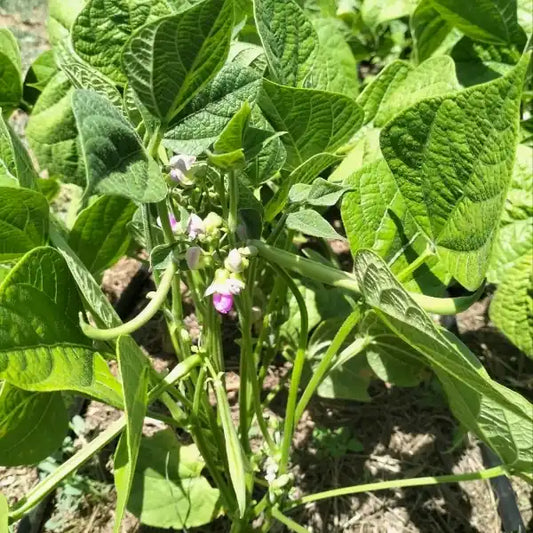
‘Blauhilde’ is annual, herbaceous and strongly climbing. It forms long, twining shoots with medium‑green foliage. The white to slightly violet‑tinged flowers appear from early summer. After flowering, long, round, violet, stringless pods develop, containing tender, cream‑coloured seeds. The root system is tap‑rooted with strong lateral roots. Annual in cultivation, not winter‑hardy.

Plant details:

  • Height: High, 250–300 cm

  • Form: Climbing, herbaceous, indeterminate

  • Leaves: Medium green, trifoliate

  • Flowers: White to softly violet

  • Pods: Violet, 20–25 cm long, round, stringless; seeds cream‑coloured
  • Flavor: Mild, aromatic, tender


 Usage & Cultivation Highlights

‘Blauhilde’ is excellent for pan dishes, vegetable sides, stews, wok dishes, tempura, pickling, fermenting and long‑term storage. The stringless pods can be steamed, boiled, fried, grilled, deep‑fried or frozen after blanching, while keeping a pleasant bite. Their mild, delicate aroma makes them versatile – from traditional home cooking to modern vegetable cuisine. Young pods pair well with herbs such as summer savoury, tarragon or lemon thyme and fit perfectly into bowls, pasta dishes, summer vegetable pans and light curries. ‘Blauhilde’ also works beautifully in oven dishes, hearty gratins, stuffed vegetables, rice and grain pans, warm mezze, vegetable antipasti, fine vegetable creams, bean pesto, marinated grilled vegetables, summer salads, vegetable chips and aromatic soup garnishes. In cold dishes, the pods enrich pickles, appetiser platters, bowl toppings and light lunch dishes. Mature seeds can be dried and used as dry beans.

In cultivation, ‘Blauhilde’ is highly reliable: it prefers sunny, warm locations and performs well even in regions with changeable summers. Thanks to its vigorous growth, it needs a stable climbing support, yet remains low‑maintenance and largely disease‑resistant. Even moisture promotes pod set, while waterlogging should be avoided. The plants thrive reliably even in less‑than‑ideal soils. As a legume, it fixes nitrogen and improves long‑term soil fertility. Its long growing season allows for an extended harvest over many weeks. ‘Blauhilde’ also impresses with strong heat tolerance, robust standability and the ability to bridge dry periods thanks to its deep taproot. The variety shows strong competitiveness against weeds, steady flowering into late summer and remarkable uniformity in pod formation. In companion planting – especially with cabbage, lettuce, maize or herbs – it remains vigorous and productive.

Compared to other pole beans, ‘Blauhilde’ stands out with its exceptionally long, violet, stringless pods, mild flavour and high yield reliability – ideal for self‑sufficiency, family gardens, mixed cropping and ecological cultivation.

Cultivation_Overview_-_Anbau_im_Uberblick_-_Visao_geral_do_cultivo_-_www

Origin & Cultivation at a Glance

First mention:

1964

Origin:

Germany

Breeder:

Not documented – traditional variety.

Propagation site:

Alentejo - Portugal

Suitable for:

Open field, Polytunnel, Greenhouse, Raised bed, Urban gardening, Vertical cultivation

Care requirements:

Low – easy to care for, ideal for beginners.

Overwintering:

Not winter-hardy – can be cultivated outdoors as an annual.

Special features:

Quickly usable, Fast-growing, High-yielding, Low-maintenance, Sun-loving / sunny, Shade-tolerant / partial shade, Heat-tolerant
Plant_Growing_Instructions_-_Pflanzen_Anbau-Anleitung_-_Instrucoes_de_cultivo_de_plantas_-_www

Cultivation guide for

<tc>Blauhilde</tc>

Growing difficulty:

Easy
Sowing in subtropical climates from March to September in sunny or partial‑shade locations – pre‑cultivation is not recommended.
In temperate regions, direct sowing from April to June after the last frost in full sun – pre‑cultivation not recommended.
Sow in deep, well‑drained, humus‑rich and nutrient‑rich loam – 2–3 cm deep. Plant spacing 30 × 60 cm.

Cultivation tips:

Direct sowing is recommended - young plants grow quickly and vigorously.
Good air circulation protects against aphids and fungal diseases.
For a staggered harvest, it’s recommended to sow seeds in intervals of 4 weeks.
Hill sowing possible – 3–4 seeds per hole with a hill spacing of 40 cm.
Biochar and rock dust improve soil structure and enhance the retention of nutrients and water.

Storage instructions:

Store seeds in a cool, dry, dark, and airtight environment to maximize shelf life and germination.
Detailed information on seed storage
Plant_Profile_-_Pflanzen_Steckbrief_-_Ficha_da_planta_-_www

Plant Profile

Plant details

Botanical name:

Phaseolus vulgaris L. 'Blauhilde'

Botanical family:

Fabaceae

Plant type:

Legumes

Growth habit:

Climbing, Herbaceous, Indeterminate growth habit

Plant width:

35 cm

Plant height:

250–300 cm

Root type:

Moderately to deep rooted, Taprooted

Hardy to:

0 °C - tolerable for a short time, but not winter-hardy.

Cultivation period:

4-6 months

Life cycle:

Annual

Propagation method:

Generative propagation by seed, Self-seeding

Propagation:

This variety is predominantly self‑fertile, occasionally cross‑pollinated by insects, and belongs to the species Phaseolus vulgaris.
For seed saving, a distance of 5–10 m from other varieties of the same species is sufficient – cross‑pollination is rare but possible.
The plant is annual – after flowering it forms small, branched inflorescences with well‑ripening seeds in dry pods.
The seeds are ready for harvest once the pods have fully dried and become straw‑brittle.

Sowing & Planting

Germination type:

Dark germinator, Temperate germinator

Sowing depth:

2-3 cm

Germination temperature:

18-25 °C

Germination time:

7-14 days

Pot culture:

Not recommended – better grown in garden beds.

Row spacing for baby leaf:

Not suitable for baby-leaf cultivation.

Plant spacing:

30 cm

Row spacing:

60 cm

Pricking out / thinning out:

No thinning required – direct sowing recommended.

Planting time:

Transplanting not required - direct sowing is recommended.

Soil

Soil type:

Deep, well-drained, humus-rich loam

Soil pH:

6.0-7.0 - slightly acidic to neutral

Nutrient requirements:

Medium feeder

Soil moisture:

Evenly moist, Sensitive to waterlogging

Soil preparation:

Loosen soil deeply before sowing, Apply compost before planting., Prepare soil weed-free and with a fine crumb structure., Mulch layer for moisture regulation

Companion planting, Crop rotation & Harvest

Companion plants:

Lettuce, Spinach, Chard, Cucurbits, Radish, Carrot, Beetroot, Corn, Dill, Borage, Calendula, Nasturtium

Incompatible plants:

Other legumes, Onion crops, Fennel, Tomato, Potato, Celery

Crop rotation guidelines:

Do not plant after other legumes – at least 4 years of spacing recommended.

Harvest time:

Summer, Autumn

Sowing to harvest:

2-3 months

Harvested parts:

Siliques

Suitable for consumption:

Yes - edible when cooked.

Intended use:

Diet cuisine, Low Carb, Steaming, Cooking, Roasting, Grilling, Baking, Deep-frying, Stuffing, Pickling, Freezing, Preserving, Drying / Dehydrating

Care & Cultivation practices

Water requirements:

Moderate to high

Plant care techniques:

Thin out after germination when sown directly, Water regularly - even during dry periods, Maintain weed-free, Create a climbing support

Plant protection:

Slug protection recommended, Well-ventilated location and good drainage recommended., Mulching recommended

Cultivation notes:

Proven and easy to cultivate Susceptible to slugs and snails in early development. At a later stage, the hardier leaves are less vulnerable. Growth stops under drought – consistent water supply required. Sensitive to waterlogging – use well-drained soil.

Other names

EN - English names:

Pole beanClimbing bean

DE - German names:

Stangenbohne

PT - Portuguese names:

Feijão trepador

ES - Spanish names:

Judía de enrame

FR - French names:

Haricot à rames

Customer Reviews

Be the first to write a review
0%
(0)
0%
(0)
0%
(0)
0%
(0)
0%
(0)

Further recommendations for you

100% open-pollinated & reproducible