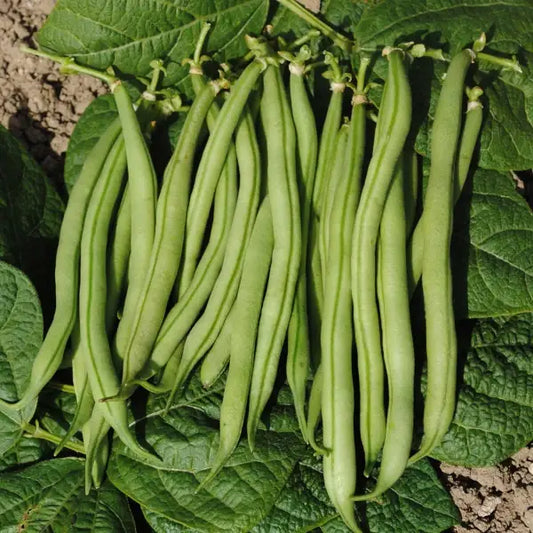
'Neckargold' Pole Bean – tender golden‑yellow climbing bean with long, stringless pods and a fine, mildly sweet flavour.
Annual, warmth‑loving legume with long, golden‑yellow, round, stringless beans and a mild‑sweet flavour. The plants grow vigorously climbing, reach 250–300 cm in height and require a support structure. They thrive reliably in sunny, warm locations in open ground, raised beds or the garden, with moderate water needs and strong yield reliability. The variety is robust, low‑maintenance and open‑pollinated – ideal for self‑sufficiency, companion planting and ecological cultivation.
 Origin & History
‘Neckargold’ is a classic golden‑podded bean from southern Germany, developed in the early 1960s. It belongs to the climbing Phaseolus vulgaris types valued for their long, golden‑yellow, stringless pods. As an open‑pollinated variety, it was selected from established wax‑bean lines and adapted to a wide range of garden soils. Botanically, it belongs to the family Fabaceae, subfamily Faboideae, genus Phaseolus.
The variety was first described in 1962 in German horticultural records, where it was introduced as a new yellow, stringless pole bean with notable yield reliability. This early documentation marks the beginning of its varietal history and already presents it as a classic wax bean that quickly established itself in Central European gardening. In the following years, it spread widely in home and self‑sufficiency gardens, where its long, fleshy pods and dependable cultivation performance became well known.
Its golden‑yellow colour gave it a distinctive character early on, making it instantly recognisable both in the garden and in the kitchen. From the beginning, ‘Neckargold’ impressed with robust plants, consistent pod set and stable yields, even in changeable summers. With its mild‑sweet flavour and strong resilience, it developed into one of Europe’s best‑known yellow pole beans. To this day, it is regarded as a trusted heritage variety of the 1960s and remains a staple in ecological and private cultivation.
 Appearance & Characteristics
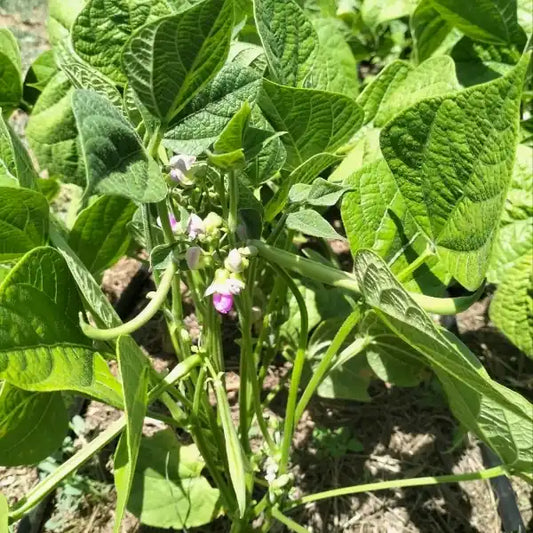
‘Neckargold’ is annual, herbaceous and strongly climbing. It forms long, twining shoots with medium‑green foliage. The white to creamy‑white flowers appear from early summer. After flowering, long, round, golden‑yellow, stringless pods develop, containing tender, cream‑coloured seeds. The root system is tap‑rooted with strong lateral roots. Annual in cultivation, not winter‑hardy.
Plant details:
Height: High, 250–300 cm
Form: Climbing, herbaceous, indeterminate
Leaves: Medium green, trifoliate
Flowers: White to creamy white
- Pods: Golden‑yellow, 20–25 cm long, round, stringless; seeds cream‑coloured
 Usage & Cultivation Highlights
‘Neckargold’ is excellent for pan dishes, vegetable sides, stews, wok dishes, tempura, pickling, fermenting and long‑term storage. The stringless pods can be steamed, boiled, fried, grilled, deep‑fried or frozen after blanching while keeping a pleasant bite. Their mild‑sweet aroma makes them versatile – from traditional home cooking to modern vegetable cuisine. Young pods pair well with herbs such as summer savoury, tarragon or lemon thyme and fit perfectly into bowls, pasta dishes, summer vegetable pans and light curries. ‘Neckargold’ also works beautifully in oven dishes, hearty gratins, stuffed vegetables, rice and grain pans, warm mezze, vegetable antipasti, fine vegetable creams, bean pesto, marinated grilled vegetables, summer salads, vegetable chips and aromatic soup garnishes. In cold dishes, the pods enrich pickles, appetiser platters, bowl toppings and light lunch dishes. Mature seeds can be dried and used as dry beans.
In the garden, ‘Neckargold’ shows impressively stable performance. The variety loves sunny, warm spots and continues to grow reliably even in changeable summers. Its vigorous climbing habit requires a solid support structure, yet it remains low‑maintenance and only mildly susceptible to disease. Even moisture supports pod formation, while the deep taproot allows the plants to bridge short dry periods with ease. ‘Neckargold’ stays vigorous and productive even in less‑than‑ideal soils. As a legume, it improves soil fertility and provides a long harvest period over many weeks. Its robust standability, strong competitiveness against weeds and consistently high flowering capacity into late summer make it an exceptionally reliable variety. In companion planting – especially with cabbage, lettuce, maize or aromatic herbs – it shows harmonious growth and stable yields.
Compared to other pole beans, ‘Neckargold’ stands out with its long, golden‑yellow, stringless pods, its mild‑sweet flavour and its high yield reliability – ideal for self‑sufficiency, family gardens, mixed cropping and ecological cultivation.