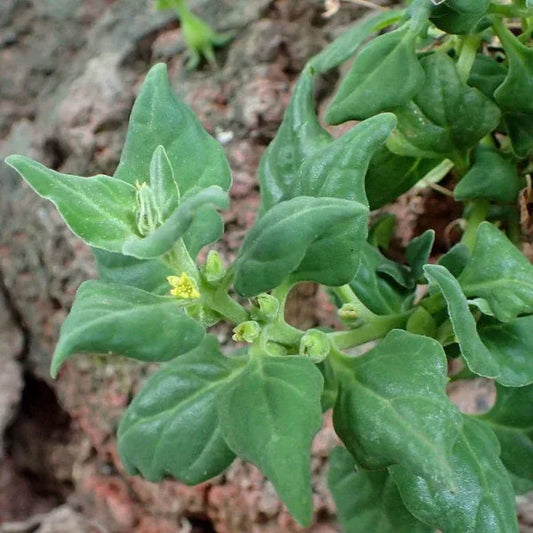
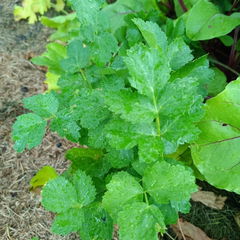
Green Purslane [Portulaca oleracea]

€2,50 EUR
Save {price}%
€1.666,67 EUR kg
Price plus shipping
Delivery time: 1-2 business days (PT – international may vary)
reicht für ca. 5 m²

In stock

Traditional cultivation method & heirloom variety. Regionally adapted landrace. Genetically stable & open-pollinated - 100% free from hybrid breeding, GMOs, and synthetic fertilizers. Organically propagated - Non-proprietary variety.

Local pickup at Benjis Seeds

Bohnensamen2

Harvest year:

2023

Seed viability:

15 years (species-specific)
Detailed information on germination capacity

Description

Cultivation & Characteristics

Tips & Reviews

The annual summer purslane is a leaf vegetable and medicinal plant and has been popular as a succulent for thousands of years. High vitamin content and many minerals help with digestive disorders and heartburn. Ideal for direct sowing, pot cultivation possible, sowing spring-summer, good for mixed culture, harvesting the leaves.

 Description 
Summer purslane is an annual succulent, leaf vegetable and medicinal plant from the Middle East and has been an integral part of vegetarian Indian cuisine for thousands of years. The heat-loving plant forms dense, thick, fleshy leaves on reddish-tinged stems. The older, mildly spicy, nutty to sour leaves are harvested with the shoot tips; young leaves have a fresh, salty taste and are eaten raw. The leaves contain very high levels of vitamins and minerals and are effective as freshly squeezed juice for digestive disorders and heartburn. A cocktail with nettle and dandelion works wonders for spring fatigue. Can be harvested several times a year; easy-care crop.

 General information 
Plant family: Portulacaceae
Life cycle:
Annual
Days to harvest:
70 days
Plant height approx.:
40 cm
Root type:
Shallow rooter
Nutrient requirements:
Low
Water requirements:
Low
Winter hardiness:
Up to 3°C
Location:
Sunny
Soil:
Permeable, humus-rich sandy loam soil

pH value: 6.5 to 7

 Sowing and planting information 
Germination type:
Light germinator
Sowing depth:
0 cm
Optimal germination temperature:
22-28 °C
Germination time:
7-20 days
Plant and row spacing:
10x30 cm

Germination ability of seeds: 15 years

 Mixed culture 
Optimal mixed culture: Strawberry, Kohlrabi, Radish, Lettuce, Rocket
Unfavorable mixed culture: -

 Sowing by climate zone 
Subtropic climate (Mediterranean) (e. g. B. Portugal, Spain, Italy)
Direct sowing from April to August is recommended. The plants should ideally be planted in a sunny location.
Moderate climate (e. g. B. Germany, Switzerland, Poland)
Direct sowing from May to June is recommended. The plants should ideally be in a sunny location.

 General recommendations 
Direct sowing is recommended. After germination, thin out the plants to the specified plant spacing.
Summer purslane prefers a permeable, nutrient-rich, rather dry and humus-rich sandy loam soil. Doesn't tolerate waterlogging.

 Additional tips 
In sunny and very sandy locations, the plants grow in a creeping manner. In order to quickly obtain a fine, crumbly and permeable soil with good nutrient and water retention capacity, additional incorporation of biochar and primary rock flour is recommended.

 Type of propagation 
Propagation occurs via seeds.

 Plant care 
It is recommended to regularly remove the top shoot tips to achieve stronger branching. Regular watering results in faster growth. No fertilization necessary.

 Other names 
Botanical names: Portulaca sativa, Portulaca oleracea var. sativa
English names: Green purslane, Summer purslane
German names: Portulak, Gemüseportulak, Sommerportulak
Portuguese names: Beldroega
Spanish names: Verdolaga
French names: Pourpier

 Origin 
Country: Portugal

Cultivation_Overview_-_Anbau_im_Uberblick_-_Visao_geral_do_cultivo_-_www

Origin & Cultivation at a Glance

First mention:

1767

Breeder:

Unknown – heritage variety

Origin:

Mediterraner Raum und Vorderasien

Propagation site:

Lower Saxony – Germany

Suitable for:

Open field, Greenhouse, Polytunnel, Balcony / pot, Urban gardening, Raised bed, Plant towers or tiered systems, Rock garden

Care requirements:

Low – easy to care for, ideal for beginners.

Overwintering:

Not winter-hardy – can be cultivated outdoors as an annual.

Suitability for cultivation and use:

Early crop, Summer crop, Fall crop, Peak season, Self-sufficiency, Biodiversity, Variety conservation, Educational projects / School garden, Direct marketing, Fresh consumption
Plant_Growing_Instructions_-_Pflanzen_Anbau-Anleitung_-_Instrucoes_de_cultivo_de_plantas_-_www

Cultivation guide for

Sommer-Portulak

Growing difficulty:

Easy
• Im subtropischen Klima von März bis September sonnig aussäen - Vorkultur nicht empfehlenswert.
• In gemäßigten Regionen ab April geschützt und sonnig aussäen - Vorkultur nicht empfehlenswert.
• Aussaat in durchlässigen, sandig-humusreichen und mäßig nährstoffreichen Lehmboden. Lichtkeimer - nicht mit Erde bedecken. Pflanzabstand: 15 × 25 cm.
For baby leaf, sow densely with row spacing of 10-15 cm.

Special features:

Annual variety / Fast-growing, Fast-growing, High-yielding, Resilient, Low-maintenance, Sun-loving / sunny, Drought-tolerant, Heat-tolerant

Cultivation tips:

Direct sowing is recommended - young plants grow quickly and vigorously.
Thin out early so the plants have enough space.
Bring pots indoors or into the greenhouse in autumn – this way the season can be significantly extended.
Fertilize sparingly - overly nutrient-rich soils reduce the aroma.
Do not cut the plant completely down to the ground, but only harvest the upper shoots. This way it will sprout again and allow for multiple harvests throughout the season.
For a staggered harvest, it’s recommended to sow seeds in intervals of 4 weeks.
Removing flowers extends leaf usage.

Storage instructions:

Store seeds in a cool, dry, dark, and airtight environment to maximize shelf life and germination.
Detailed information on seed storage
Plant_Profile_-_Pflanzen_Steckbrief_-_Ficha_da_planta_-_www

Plant Profile

Plant details

Botanical name:

Portulaca oleracea L. var. sativa (Haw.) DC.

Growth habit:

Niederliegend-teppichartig

Botanical family:

Portulacaceae

Plant height:

30 cm

Plant type:

Leafy vegetables

Plant width:

50 cm - teppichartig

Life cycle:

Annual

Root type:

Shallow-rooted, Taprooted

Cultivation period:

3-5 Monate

Hardy to:

5 °C - nur bei milder Witterung überlebensfähig.

Cultural meaning:

Historical, Traditional, Regional landrace

Propagation method:

Generative propagation by seed

Propagation:

• Diese Sorte ist überwiegend selbstbefruchtend, gelegentlich auch durch Insekten bestäubt und gehört zur Art Portulaca oleracea.
For seed production, a minimum distance of 50–100 m from other varieties of the same species is recommended to prevent cross-pollination.
The plant is annual - after flowering it forms small inflorescences with numerous, small, well‑ripening seeds.
The seeds are ready for harvest once the seed heads have completely dried and become straw‑like and brittle.

Sowing & Planting

Germination

Planting

Germination type:

Light germinator, Temperate germinator

Pot culture:

Requires a minimum container size of 3 liters.

Sowing depth:

0-0,5 cm

Plant spacing:

15 cm

Germination temperature:

18-25 °C

Row spacing:

25 cm

Germination time:

5-10 days

Row spacing for baby leaf:

5-10 cm

Pricking out / thinning out:

No thinning required – direct sowing recommended.

Planting time:

Transplanting not required - direct sowing is recommended.

Soil

Soil type:

Well-drained, humus-rich sandy loam soil

Soil pH:

6.0-7.0 - slightly acidic to neutral

Nutrient requirements:

Light feeder

Soil moisture:

Moderately moist, Adaptable, Drought-tolerant, Sensitive to waterlogging

Soil preparation:

Loosen soil before sowing, Prepare soil weed-free and with a fine crumb structure., Mulch layer for moisture regulation

Companion planting, Crop rotation & Harvest

Companion plants:

Lettuce, Tomato, Pepper / Chili pepper, Bean, Radish, Carrot, Onion crops, Basil, Dill, Coriander

Incompatible plants:

Brassicas, Potato, Corn, Chard, Beetroot

Crop rotation guidelines:

Ripens in a short time and is therefore ideally suited as an intercrop or follow-up crop.

Harvest time:

Summer, Autumn

Sowing to harvest:

0,7-1 months

Harvested parts:

Leaves, Stems, Shoot tips

Suitable for consumption:

Yes - edible raw.

Intended use:

Diet cuisine, Low Carb, Culinary herb, Raw consumption, Salad, Steaming, Cooking, Pickling, Fermentation, To purée, Smoothies, Freezing, Drying / Dehydrating, Natural garden

Care & Cultivation practices

Water requirements:

Low

Plant care techniques:

Thin out after germination when sown directly, Irrigate occasionally, Maintain weed-free

Plant protection:

Well-ventilated location and good drainage recommended., Mulching recommended

Cultivation notes:

Proven and easy to cultivate Susceptible to slugs and snails in early development. At a later stage, the hardier leaves are less vulnerable. Sensitive to waterlogging – use well-drained soil.

Other names

EN - English names:

• Summer purslane • Garden purslane

DE - German names:

• Sommer-Portulak • Gemüse-Portulak

PT - Portuguese names:

• Beldroega

ES - Spanish names:

• Verdolaga

FR - French names:

• Pourpier potager
Practical_Planting_and_Care_Tips_-_Praktische_Aussaat-_und_Pflegetipps_-_Dicas_praticas_de_sementeira_e_cuidados_-_www

Practical sowing and care tips

Saattiefe - Bedingt Keimverhalten und Gesundheit

Sowing depth - Determines germination and health

Germination rate too low or plants bending over? Decisive factors for sowing depth. In this article from my gardening handbook,...
Read more here
Aussaat-Arten - Direktsaat und Vorkultivierung

Sowing methods - direct sowing and pre-cultivation

How do I sow seeds: direct sowing or pre-cultivation? In this article, we'll explain the background of both methods, along...
Read more here
Keimarten und Umgebungsfaktoren - Wie Samen keimen

Germination types and environmental factors - How seeds germinate

Which germination types are relevant, and what should you consider when germinating seeds? In this article, we've compiled a simple,...
Read more here
Mulch - Wasser sparen und Wachstum fördern

Mulching - save water and promote growth

Nature as a model - mulching has numerous advantages that benefit the health of soil life and plants. In this...
Read more here

Customer Reviews

Be the first to write a review
0%
(0)
0%
(0)
0%
(0)
0%
(0)
0%
(0)

Further recommendations for you

100% open-pollinated & reproducible